
SEO for contractors helps construction and home improvement businesses reach people who search online for their services. It can help you rank higher on Google, appear in local search results, build trust, and turn website visits into calls, quote requests, and new projects.
If you run a roofing company, remodeling business, general contracting firm, plumbing company, or another contracting business, your website should do more than show your services. It should help the right customers contact you when they need work done.
That takes more than adding keywords to a few pages. You need a clear SEO plan that covers your website, local search presence, service pages, customer reviews, useful content, and lead tracking.
At SEO Revive, we approach SEO as a way to support business growth. Rankings and traffic matter, but the real goal is to bring qualified visitors to your website and turn them into potential customers.
This guide explains how contractor SEO works, which strategies matter most, what it may cost, and how to build a plan that supports steady business growth.
What Is SEO for Contractors?
SEO for contractors is the process of improving a contracting business’s website and online presence so that it can appear in relevant search results on Google and other search engines.
It helps potential customers reach your business when they search for services such as roof repair, kitchen remodeling, home additions, commercial construction, or general contracting.
For example, a homeowner might search for “roofing contractor in Austin” after a storm. A business owner might search for “commercial general contractor near me” before starting a new project.
Your business has a better chance of earning that customer’s attention when your website clearly explains your services, serves the target area, and provides useful information.
Contractor SEO covers several areas:
- Local SEO: Improve your presence in Google Maps and local search results.
- On page SEO: Improve service pages, titles, headings, content, and internal links.
- Technical SEO: Make sure search engines can access, crawl, and index important pages.
- Content marketing: Publish useful guides that answer customer questions.
- Link building: Earn relevant links from trusted websites to build your site’s authority.
- Conversion rate optimization: Make it easier for visitors to call, request a quote, or book an estimate.
- AI search optimization: Help your business present clear, useful, and consistent information across its online presence.
A strong SEO plan connects these activities. It does not treat rankings as the only measure of success.
Why Do Contractors Need SEO?
Many people search online before they contact a contractor. They may compare services, read reviews, check photos of past work, and request quotes from several businesses.
If your company does not appear for relevant searches, potential customers may contact a competitor instead.
SEO helps address this problem by improving your visibility when people need the services you provide.
1. Reach People Who Need Your Services
Someone searching for “bathroom remodeling contractor in Dallas” has a clear service need and a location in mind.
A well planned service page can help your business appear for relevant searches. This gives you a chance to connect with people who may be ready to discuss a project.
2. Build Trust Before the First Call
Contracting projects often involve a major expense. Customers want to know that the company they choose is reliable and capable.
A useful website can support that decision with:
- Photos of completed projects.
- Clear descriptions of your services.
- Customer reviews and testimonials.
- Details about your process.
- Information about licenses and insurance where applicable.
- Case studies that explain the work completed.
- A clear way to request an estimate.
These details give visitors a better reason to trust your business.
3. Build a Long Term Source of Leads
Paid ads can bring traffic while a campaign is active. SEO works differently.
It aims to improve your website’s ability to earn organic traffic over time. Results are not instant, and rankings can change, but useful pages can continue to attract visitors after publication.
SEO still requires ongoing work. Competitors can improve their websites, customer demand can change, and search engines can update their systems.
4. Reduce Dependence on One Marketing Channel
A contractor who relies only on referrals may face gaps when referrals slow down. A business that relies only on paid ads may struggle when costs rise.
SEO gives you another way to reach potential customers.
It can also support paid search, email marketing, social media, and referral campaigns by giving customers a strong website to visit after they hear about your business.
5. Reach Customers for Specific Services
Not every customer needs the same type of contractor.
A person searching for a roof replacement has a different need from someone planning a commercial office renovation.
Dedicated service pages help your website address these needs clearly. They also help search engines understand which services your business offers.
How Does Contractor SEO Work?
Contractor SEO starts with understanding what customers search for and what your business wants to achieve.
The work then moves through research, website improvements, content creation, local SEO, authority building, and performance tracking.
A typical process looks like this:
- Review the website, current rankings, and competitors.
- Identify valuable keywords and the intent behind them.
- Fix technical issues that affect crawling, indexing, and page experience.
- Improve service pages and location pages where they provide real value.
- Strengthen the Google Business Profile.
- Publish helpful content that answers customer questions.
- Earn relevant links and build trust across the web.
- Track leads, rankings, traffic, and conversion rates.
- Improve the strategy based on real performance data.
The order may change based on your website’s condition. A site with indexing problems needs technical work before a large content campaign. A local business with a weak Google Business Profile may need to address that issue early.
The best plan starts with the problems that have the greatest effect on visibility and leads.
10 SEO Strategies That Help Contractors Win More Business
1. Start With Contractor Keyword Research
Keyword research shows how people search for your services. It helps you decide which pages to improve, which pages to create, and which topics deserve attention.
The goal is not to target every possible keyword. It is to focus on searches that match your services, service areas, and business goals.
Contractor keywords usually fall into several groups.
Service keywords
These describe the work a customer needs.
- Roofing contractor
- Kitchen remodeling services
- Bathroom renovation contractor
- Commercial general contractor
- Home addition contractor
- Concrete contractor
- Foundation repair contractor
Local keywords
These combine a service with a place.
- Roofing contractor in Phoenix
- Kitchen remodeling company in Denver
- General contractor in Tampa
- Concrete contractor near me
Commercial keywords
These can signal that a person is comparing providers or planning to hire one.
- Best roofing company in Phoenix
- Commercial construction companies
- Residential general contractor
- Contractor SEO services
- SEO company for contractors
Question based keywords
These reflect questions customers ask before making a decision.
- How much does a roof replacement cost?
- How long does a kitchen remodel take?
- Do I need a permit for a home addition?
- How do I choose a general contractor?
- What should I ask before hiring a roofing company?
Each group serves a different purpose. Service and local keywords often support service pages. Question based searches may suit blog posts, FAQs, or detailed service information.
How to choose the right keywords
Assess each keyword using four factors.
| Factor | What to Check |
|---|---|
| Search Intent | Does the person want a service, an answer, or a comparison? |
| Business Value | Could this search lead to a suitable project? |
| Local Relevance | Can your business serve the person searching? |
| Competition | How strong are the pages already ranking? |
Search volume can help you estimate demand, but it should not be your only deciding factor.
A keyword with modest search volume may bring more valuable enquiries than a broad term that attracts people outside your service area.
For example, “commercial roofing contractor in Phoenix” may be more useful to a commercial roofing company than a broad term such as “roofing.”
At SEO Revive, keyword research should connect search demand with the services a business wants to sell. That keeps the strategy focused on qualified leads rather than traffic alone.
2. Improve Your Google Business Profile
For contractors who serve local customers, Google Business Profile is an important part of local SEO.
It can help your business appear in Google Maps and local search results. Your profile can also show your contact details, business hours, reviews, photos, and other relevant information.
Start with these steps:
Use accurate business details. Keep your business name, phone number, website, hours, and address or service area accurate.
Choose the right primary category. Select the category that best describes your main business. Add other relevant categories only when they accurately describe your services.
Describe your services clearly. Add the services your business actually provides. Do not add unrelated services to target more searches.
Upload real project photos. Show completed work, your team, equipment, and other useful images from your business.
Ask customers for honest reviews. Request feedback after a project is complete. Make it easy for customers to leave a review, but do not pressure them or offer rewards in exchange for positive reviews.
Respond to reviews. Thank customers for positive feedback. Address complaints in a calm and professional way. Avoid sharing private customer or project details.
Keep the profile active and accurate. Update relevant details when your services, hours, or contact information change.
Google says local results mainly depend on relevance, distance, and prominence. A complete profile can help Google understand your business, but it cannot override distance or guarantee a top position.
You cannot pay Google to improve your organic local ranking.
Google’s official guidance is available in its local ranking help documentation.
What if you do not have a customer facing office?
Some contractors operate from home or travel to customer sites instead of serving customers at a public office.
Google Business Profile rules distinguish between storefront businesses and service area businesses. If you do not serve customers at your business address, you generally need to hide that address and set your service area according to Google’s rules.
Do not create fake offices or use addresses where your business is not eligible to operate a profile.
3. Create a Strong Page for Every Main Service
Your website should explain what you do and make it easy for customers to take the next step.
A single page that lists every service may not provide enough detail for customers or search engines.
If your business offers roofing, siding, gutters, and roof inspections, consider a dedicated page for each major service when there is enough useful information to support it.
A roofing service page could include:
- A clear description of the roofing work you provide.
- The types of properties you serve.
- The materials and methods you work with.
- Common problems you solve.
- Your process from inspection to completion.
- Real project photos.
- Relevant reviews or case studies.
- Answers to common customer questions.
- A clear way to request an estimate.
The content should reflect the actual service. Do not publish several pages that say almost the same thing with only the service name changed.
For example, a roof repair page should explain repair work, common signs of damage, inspection steps, and when replacement may be worth considering. A roof replacement page should explain the replacement process, material choices, preparation, and project planning.
These differences make each page more useful.
Use clear page titles and headings
Your title tag should describe the service and, where useful, the location.
Example: Roof Repair Services in Phoenix | Company Name
The page should explain the service early. Avoid vague headings that force visitors to scroll before they understand what you offer.
Use related terms naturally. You do not need to repeat the exact keyword in every heading.
4. Build Useful Location Pages
Location pages can help contractors reach customers in different towns, cities, or service areas.
However, adding dozens of pages with nearly identical text is not a sound strategy. Google identifies certain pages created mainly to capture similar searches and send visitors elsewhere as doorway abuse.
Each location page should give people useful information about working with your company in that area.
A strong location page may include:
- The specific services available in the area.
- Real projects completed there.
- Relevant photos and case studies.
- Local property or project needs that your team can address.
- Service limitations or travel details, where relevant.
- Genuine customer feedback from the area.
- Clear contact and estimate options.
For example, a general contractor serving Dallas and Fort Worth may have separate location pages if each page provides useful, distinct information about the company’s work in those markets.
If the company has never worked in a particular city and has no meaningful local information to offer, a separate page may not be necessary.
Build pages around real service coverage and customer needs, not a list of city names.
5. Publish Content That Helps Customers Make Decisions
Blog content can support contractor SEO by answering questions that arise before, during, and after a project.
Good content does more than attract search traffic. It helps potential customers understand their options and decide what to do next.
Here are examples of useful topics.
| Blog Topic | Customer Need |
|---|---|
| How Much Does Roof Replacement Cost? | Budget planning |
| Roof Repair vs. Roof Replacement | Choosing the right service |
| How Long Does a Kitchen Remodel Take? | Project planning |
| Questions to Ask Before Hiring a General Contractor | Comparing contractors |
| What to Include in a Home Renovation Budget | Cost planning |
| Do You Need a Permit for a Home Addition? | Understanding local requirements |
| How to Prepare Your Home for a Remodeling Project | Preparing for work |
| Signs Your Roof May Need Repair | Understanding a problem |
| Commercial Construction Project Planning Checklist | Planning a business project |
| What to Expect During a Bathroom Remodel | Setting expectations |
The best topics depend on your services and the questions your customers ask.
Make cost guides useful
Cost related searches can attract people who are planning a project. A useful guide should explain the factors that affect price rather than publish a single number without context.
For a roofing project, these factors may include:
- Roof size and shape.
- Material choice.
- Roof pitch and access.
- Existing damage.
- Removal and disposal requirements.
- Local labor costs.
- Permit requirements.
- Additional structural work.
If you include price ranges, state the market and date they apply to. Explain what is included and what could change the final quote. Use current, credible information rather than unsupported estimates.
Show first hand knowledge
Contractors have useful knowledge that general marketing articles often miss.
A project case study can explain the original problem, the work completed, the choices made, and the final outcome. Photos, measurements, and customer feedback can add useful detail when they are accurate and shared with permission.
Do not invent projects, customer stories, or results.
Google’s guidance on helpful people first content stresses usefulness, originality, accuracy, and clear authorship. These principles are a sound basis for your content strategy.
6. Improve Technical SEO
Technical SEO helps search engines access and understand your website.
A page may have strong content but still struggle if it cannot be crawled, is blocked from indexing, or has technical problems that prevent it from appearing properly in search results.
Start with these checks.
Indexing
Use Google Search Console to check whether your important service and location pages are indexed. Review any exclusions and determine whether they are intentional.
Crawlability
Make sure important pages can be reached through normal website links. Review robots.txt rules and check that pages intended for search are not blocked by mistake.
XML sitemap
Keep your XML sitemap limited to the canonical URLs you want search engines to index. Submit it through Google Search Console and review any reported issues.
Page titles and meta descriptions
Write unique titles and useful descriptions for important pages. Avoid duplicate titles and vague descriptions that do not reflect the page.
Canonical tags
Use canonical tags to identify the preferred URL when duplicate or very similar pages exist. Do not use them as a substitute for fixing a poor site structure.
Mobile experience
Check whether customers can read your content, tap phone numbers, use forms, and view photos on a mobile device.
Page speed
Compress large images, reduce unnecessary scripts, and review loading performance. Good speed supports usability, although speed alone will not guarantee strong rankings.
Broken links and redirects
Fix broken internal links. Use suitable redirects when pages move or URLs change. Avoid sending every deleted page to the homepage.
Structured data
Use relevant structured data when it accurately describes the page and follows Google’s guidelines. A local business may benefit from suitable LocalBusiness markup, while a service page may need a different approach depending on the information it contains.
Structured data can help search engines interpret page information, but it does not guarantee a rich result or higher ranking.
HTTPS
Use HTTPS across the website and fix mixed content or certificate issues.
A technical audit should focus on problems that affect important pages. It should not turn into a long list of minor warnings that have little effect on users or search performance.
7. Build Relevant Backlinks
Backlinks are links from other websites to yours. Relevant, editorially earned links can help search engines understand how your business fits into the wider web.
For contractors, link building should focus on genuine business relationships, useful resources, and relevant industry coverage.
Consider these approaches:
Local business relationships
Work with architects, interior designers, suppliers, property managers, and other businesses where a genuine partnership exists. Some may mention your business or link to a useful project page.
Supplier and manufacturer resources
Check whether manufacturers or suppliers maintain directories of qualified contractors. Apply only when you meet their requirements.
Project features
A completed project may be featured by a designer, architect, community group, trade publication, or property related website. Share useful project details and high quality images when appropriate.
Local sponsorships
If your company supports a local event, trade group, or community project, the organization may list your business. Choose sponsorships for their real value, not only for a link.
Useful resources
Create guides, checklists, or project planning tools that other websites may want to reference.
Avoid buying links that pass ranking credit, using automated link schemes, or publishing low quality guest posts purely to build backlinks.
A large backlink count does not automatically mean a strong link profile. Relevance, quality, and the context of the link matter.
SEO Revive’s link building work should support a wider strategy for visibility and trust, not focus on link volume alone.
8. Earn More Customer Reviews
Reviews can help potential customers compare contractors. They can also support local visibility.
A customer who sees clear feedback about communication, workmanship, punctuality, and project management may feel more comfortable contacting your company.
Build a simple review process.
- Complete the project and confirm that the customer is satisfied with the work.
- Send a polite message with a direct link to your review page.
- Ask for honest feedback without suggesting a rating.
- Respond to reviews in a professional way.
- Review recurring feedback and improve your service where needed.
Do not buy reviews, write fake reviews, or offer rewards in exchange for positive ratings.
Do not ask only happy customers to leave public reviews while discouraging unhappy customers. Your process should allow customers to share honest feedback.
Reviews are also a useful source of business insight. If several customers mention unclear schedules or poor updates, that may reveal an area where your service process needs attention.
9. Improve Website Conversion Rates
SEO can bring visitors to your website, but traffic does not automatically turn into enquiries.
Your site should make the next step clear and simple.
For a contractor, useful conversion options include:
- Call the business.
- Request a quote.
- Book an inspection.
- Schedule an estimate.
- Submit project details.
- Ask a question about a service.
Place these options where they make sense. A visitor reading a roof replacement guide may want to request an inspection, while someone viewing a commercial construction case study may want to discuss a larger project.
Make your contact forms easy to use
Ask only for information that helps your team respond.
A basic form may request:
- Name.
- Phone number or email.
- Service needed.
- Project location.
- A short description of the work.
You may need extra details for complex commercial projects, but avoid making every visitor complete a long form.
Build trust near the enquiry point
Visitors may hesitate if they cannot tell who will handle their project.
Useful trust signals include real project photos, relevant qualifications, accurate license information, customer reviews, clear service areas, and a description of your process.
Avoid fake badges, unsupported claims, or guarantees that your business cannot honor.
Measure lead quality
Do not judge the website only by the number of form submissions.
Track whether enquiries match your services, service area, budget, and project capacity. A smaller number of qualified leads may be more valuable than a large number of irrelevant enquiries.
Conversion rate optimization can help you identify where visitors leave the site and which changes make it easier for them to contact you.
10. Track SEO Results and Improve the Plan
SEO needs regular measurement. Without tracking, it is hard to tell which work supports business growth.
Use Google Search Console to review organic search performance. Use an analytics platform to measure website activity and conversions, with suitable consent and privacy settings.
Track these metrics:
| Metric | Why It Matters |
|---|---|
| Organic Clicks | Shows visits from unpaid search results. |
| Search Impressions | Shows how often pages appear in search results. |
| Keyword Positions | Helps monitor visibility for target searches. |
| Service Page Traffic | Shows which services attract attention. |
| Local Search Visibility | Helps assess local performance. |
| Calls and Form Submissions | Measures enquiry activity. |
| Qualified Leads | Shows whether enquiries match your business. |
| Booked Estimates | Connects marketing with sales activity. |
| Won Projects | Helps assess commercial value. |
| Cost per Qualified Lead | Helps compare marketing efficiency. |
A ranking report alone is not enough. A page may rank well for a broad keyword but attract few useful enquiries.
Likewise, a page may bring fewer visitors but produce valuable commercial leads.
Connect SEO reporting to your sales process wherever possible. Record the original source of enquiries and, if your systems allow it, track which enquiries become estimates and completed projects.
Review the data regularly and use it to decide which pages need better content, which services need more visibility, and where technical work should take priority.
SEO for Different Types of Contractors
The core principles of contractor SEO remain similar, but the strategy should reflect the type of work you do.
SEO for General Contractors
General contractors may handle renovations, additions, new builds, and larger construction projects.
Their websites should explain the types of projects they accept, the property types they serve, their project management process, and the areas they cover.
Useful content may include renovation planning guides, project timelines, contractor selection advice, and case studies showing completed work.
For commercial projects, pages can also address procurement processes, project scope, relevant qualifications, and the types of clients served.
SEO for Roofing Contractors
Roofing SEO often targets searches related to repairs, replacements, inspections, and specific roofing materials.
Separate pages can explain each major service. Useful supporting content may cover roof damage, material comparisons, maintenance, replacement planning, and insurance related questions.
Be careful with insurance content. Explain your role accurately and avoid promising that an insurer will approve a claim.
Real project photos and clear service information can help customers understand the work you perform.
SEO for Remodeling Contractors
Remodeling companies often compete for projects such as kitchen renovations, bathroom remodeling, basement finishing, and whole home updates.
Project galleries and detailed case studies can play an important role.
Show the original challenge, the scope of work, material choices, and the finished space. Include budget or timeline details only when they are accurate and relevant.
Location pages may also help when the business serves several distinct markets.
SEO for Commercial Contractors
Commercial contractors may target business owners, property managers, developers, and procurement teams.
Their search strategy should reflect these audiences. Relevant pages may cover commercial construction, tenant improvements, office renovations, industrial facilities, or other specialist services.
Useful content can address project planning, safety processes, scheduling, procurement, and coordination with other professionals.
Commercial SEO may produce fewer enquiries than residential SEO, but each opportunity may involve a larger project. Lead quality matters more than raw traffic volume.
SEO for Plumbing, Electrical, and HVAC Contractors
These businesses often need strong local visibility because customers may need a repair, installation, replacement, or maintenance service in a specific area.
Create clear pages for the main services you provide. Explain which work you handle, whether emergency appointments are available, and which areas you serve.
For work that requires a license or specialist qualification, present accurate details and avoid claims that you cannot verify.
Useful supporting content can answer questions about maintenance, warning signs, service options, and when a professional inspection is needed.
Local SEO vs. General SEO for Contractors
Local SEO and general SEO work together, but they serve different purposes.
| Local SEO | General SEO |
|---|---|
| Focuses on visibility in a defined service area. | Can reach people across a wider market. |
| Uses Google Business Profile and local search signals. | Relies heavily on website relevance, content, links, and technical health. |
| Helps customers compare nearby businesses. | Helps customers find service pages and useful information. |
| Often supports calls and local enquiries. | Can support local or broader commercial enquiries. |
| Important for contractors serving specific towns or cities. | Useful for service research and broader industry searches. |
A contractor serving homeowners in one city will usually place strong emphasis on local SEO.
A construction company that works across several states or targets large commercial contracts may need a broader strategy as well.
Many businesses need both. The right mix depends on where your customers are, which services you offer, and how projects are won.
How Much Does SEO for Contractors Cost?
The cost of SEO for contractors depends on the size of the website, the level of competition, the number of services and locations, the condition of the site, and the amount of work required.
There is no single price that fits every contractor.
A small local business with a few service pages may need a different plan from a multi location company with hundreds of pages and several service lines.
Common pricing models include the following.
Monthly retainer
The business pays a recurring fee for ongoing SEO work. This may cover technical improvements, keyword research, content marketing, local SEO, link building, reporting, and conversion improvements.
Fixed project fee
A defined project may cover an SEO audit, website migration review, local SEO setup, or a specific group of technical fixes.
Hourly consulting
An SEO consultant may charge for strategic advice, audits, reviews, or help with an in house marketing team.
Before choosing a provider, ask what the fee covers, who will carry out the work, what the reporting includes, and which tasks require extra payment.
Compare proposals based on the work and business goals, not price alone.
Be cautious of agencies that promise a #1 ranking, guarantee a fixed number of leads, or offer the same package to every business without reviewing its market.
A useful proposal should explain the current problems, planned work, priorities, reporting process, and how success will be measured.
How Long Does SEO Take to Work for Contractors?
SEO does not have a fixed timeline. Some improvements may help search engines access or understand pages sooner, while stronger organic visibility may take longer to develop.
The timeline depends on factors such as:
- The website’s current condition.
- Existing rankings and organic traffic.
- Competition in the target market.
- The strength of the business’s online presence.
- The number of services and locations involved.
- The quality and depth of existing content.
- The resources available to carry out improvements.
A new website with no established search presence may need more time than an older site with useful content and a strong backlink profile.
Local visibility can also vary by search location and competition.
An SEO company should set realistic expectations after reviewing the website and market. It should not promise a specific ranking date.
What should happen during the first six months?
The following is an example of how a campaign might be organized. The actual plan should change based on the audit and early results.
| Period | Main Focus |
|---|---|
| Month 1 | Audit the site, research keywords, review competitors, and set up tracking. |
| Month 2 | Fix high-priority technical issues and improve core service pages. |
| Month 3 | Improve local SEO, review management, internal links, and important content. |
| Months 4 and 5 | Publish useful content, strengthen authority, and improve underperforming pages. |
| Month 6 | Review lead quality, rankings, conversions, and the next set of priorities. |
This is a work plan, not a promise of results by a particular month. Some websites need more technical work, while others can move faster because their foundations are already strong.
SEO vs. Google Ads for Contractors
SEO and Google Ads can both support lead generation, but they work in different ways.
| SEO | Google Ads |
|---|---|
| Earns unpaid search visibility. | Places paid ads in eligible search placements. |
| Usually requires ongoing work before strong results develop. | Can begin generating traffic soon after a campaign launches. |
| Does not charge for each organic click. | Often charges based on ad clicks or other campaign terms. |
| Can build long-term visibility through useful pages. | Traffic depends on budget, targeting, competition, and campaign performance. |
| Can support a wide range of search intents. | Can target specific searches, audiences, and campaign goals. |
SEO is not free. It requires time, expertise, content, technical work, and other resources.
Google Ads is not automatically better for urgent lead needs, either. Poor targeting, weak landing pages, or low conversion rates can waste ad spend.
For many contractors, a combined plan makes sense. Paid ads may support immediate demand while SEO builds organic visibility over time.
The decision should reflect your budget, capacity, project value, and need for leads.
How to Choose an SEO Company for Contractors
Hiring an SEO company can help when you lack the time, skills, or team needed to manage the work in house.
However, not every agency will understand your business or provide the same level of service.
Use these questions when comparing providers.
1. Do They Understand Your Business?
A contractor’s website has different needs from an online store or a software company.
Ask how the agency would approach your service pages, local visibility, project galleries, location strategy, and lead tracking.
The answers should relate to your actual services and target market.
2. Can They Explain Their Strategy?
A good SEO company should explain what it plans to do and why.
You should understand which problems matter most, what work will be completed, and how progress will be reviewed.
Be careful if the proposal relies on vague promises or a long list of activities with no clear connection to business goals.
3. How Do They Measure Success?
Rankings and traffic are useful, but they do not tell the whole story.
Ask whether the agency can help measure calls, forms, qualified enquiries, booked estimates, and other meaningful outcomes.
Make sure the reporting process matches your ability to track leads and sales.
4. Do They Use Sustainable SEO Practices?
Ask how the agency approaches link building, content, local SEO, and technical improvements.
Avoid providers that use fake reviews, misleading business profiles, mass produced pages, or link schemes.
These methods can put your website or business profile at risk.
5. Will You Own Your Website and Data?
You should retain appropriate access to your website, domain, Google Business Profile, analytics, and Search Console.
Ask who owns the content and other deliverables created during the engagement. Review contract terms before signing.
6. Can They Show Relevant Evidence?
Ask for case studies or examples that explain the work performed and the results measured.
Look for clear context. A useful case study explains the starting point, the strategy, the time period, and the outcomes.
Do not rely on screenshots alone or accept results that have no explanation.
Why Work With SEO Revive?
SEO Revive provides digital marketing services designed to improve online visibility and support business growth.
For contractors, SEO work should begin with the business itself. Which services are most valuable? Which areas can the company serve? What makes it different from competitors? What stops website visitors from becoming qualified leads?
These questions help shape a strategy that supports real business goals.
Our services can support different parts of that plan.
SEO services
Improve website structure, page relevance, internal links, and search visibility for important services.
Local SEO
Improve your local search presence through relevant website improvements and accurate business information.
Technical SEO
Identify and address issues that affect crawling, indexing, site structure, and page performance.
Content marketing
Create useful service pages, guides, and supporting content based on customer needs and search intent.
Link building
Support website authority through relevant, legitimate link acquisition.
Conversion rate optimization
Improve the website experience so visitors can take the next step with less friction.
AI search optimization
Strengthen the clarity, usefulness, and consistency of your business information to support visibility across evolving search experiences.
Not every contractor needs every service at once. The right approach depends on the audit, competition, business goals, and resources available.
We focus on a clear plan, useful work, and reporting that helps you understand what is improving and what needs attention.
AI Search Optimization for Contractors
Customers may now use AI powered search experiences to ask questions, compare services, and research businesses.
This adds another reason to keep your website information clear and useful.
AI search optimization should build on sound SEO practices rather than replace them.
Start with these steps:
Explain your services clearly. Each main service page should state what you do, who you serve, and what customers can expect.
Publish useful answers. Cover common project questions, cost factors, timelines, material choices, and service limits.
Show real evidence. Use accurate project examples, genuine reviews, qualifications, and clear business information.
Keep your business details consistent. Review your website, Google Business Profile, and relevant business listings for errors.
Use descriptive headings. Organize content so people and search systems can understand each section.
Add suitable structured data. Use markup only when it accurately represents visible page content and follows the relevant guidelines.
Track referral and lead data where possible. Review analytics to see whether AI search sources contribute to visits or enquiries, while recognizing that attribution may be incomplete.
There is no reliable shortcut that guarantees your business will appear in AI generated answers. The goal is to make your information accurate, useful, and easy to understand.
Common Contractor SEO Mistakes to Avoid
Small mistakes can waste time and weaken your online presence. Review these areas before expanding your campaign.
Targeting Every Keyword on One Page
A page that tries to rank for roofing, remodeling, plumbing, and commercial construction may not answer any of those needs well.
Create focused pages for your main services and connect them through useful internal links.
Publishing Thin Location Pages
Changing only the city name across dozens of pages creates little value.
Publish a location page when you can provide relevant details about your services and work in that area.
Ignoring Google Business Profile
An incomplete profile can leave customers with missing or incorrect information.
Keep the profile accurate and make sure it reflects your real business.
Buying Fake Reviews
Fake reviews can damage trust and violate platform rules.
Ask for honest feedback and use complaints as a chance to improve your service.
Building Low Quality Backlinks
Links from irrelevant or untrustworthy websites may bring little value and can create risk when they are part of manipulative schemes.
Focus on relevant relationships and legitimate editorial links.
Writing Content Without a Clear Purpose
A blog post should answer a real question or support a useful business goal.
Do not publish content simply because a keyword tool shows search volume.
Ignoring Lead Tracking
A rise in traffic is not enough to prove that SEO is helping the business.
Track enquiries and, where possible, connect them to estimates and completed projects.
Expecting Instant Results
SEO takes time, and competition can change.
Set clear priorities, review progress, and adjust the plan based on evidence rather than expecting a fixed result by a fixed date.
A Practical 90 Day SEO Plan for Contractors
If you want to start improving your website, use this plan as a starting point.
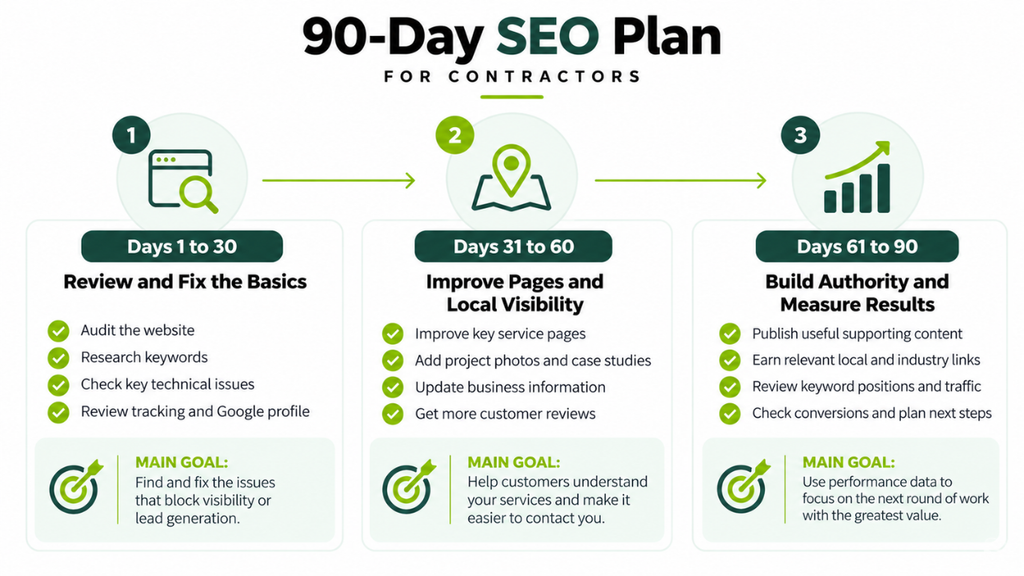
Days 1 to 30: Review and Fix the Basics
- Audit the website and check important pages for indexing issues.
- Review Google Search Console and analytics data.
- Research service and location keywords.
- Compare the main competing websites.
- Review the Google Business Profile.
- Check contact forms, phone links, and lead tracking.
- Fix the most important technical issues.
- Improve the titles and content of core service pages.
Main goal: Build a clear picture of the current problems and fix issues that block visibility or lead generation.
Days 31 to 60: Improve Pages and Local Visibility
- Expand the most important service pages.
- Add real project photos and case studies.
- Improve internal links between related pages.
- Update accurate business information and service areas.
- Create a simple process for requesting customer reviews.
- Publish useful content based on real customer questions.
- Improve quote forms and contact options.
Main goal: Help customers understand your services and make it easier for them to contact your business.
Days 61 to 90: Build Authority and Measure Results
- Publish the next set of useful supporting content.
- Pursue relevant local and industry links
- Review keyword positions and organic clicks.
- Check which pages bring qualified enquiries.
- Review call and form conversion rates.
- Improve pages that receive traffic but produce few enquiries.
- Set priorities for the next quarter.
Main goal: Use real performance data to decide where the next round of work will have the greatest value.
This plan is a practical starting point, not a guarantee of rankings or leads within 90 days. The workload should match your website, market, and available resources.
Contractor SEO Checklist
Use this checklist to review your website, local SEO, content, and tracking. Tick each task as you complete it.
Website
Local SEO
Content & Authority
Measurement
You do not need to complete every item at once. Start with the issues that affect your most valuable services and the customers you want to reach.
Final Thoughts
SEO for contractors works best when it connects search visibility with the needs of real customers.
Your website should explain your services, show why customers can trust your work, and make it easy to request an estimate. Your local presence should be accurate. Your content should answer useful questions. Your SEO plan should also measure whether the right people are contacting your business.
Start with the services that matter most to your company. Fix the main website issues, strengthen your local presence, improve key pages, and build from there.
SEO Revive can support contractors with SEO, local SEO, technical SEO, content marketing, link building, conversion rate optimization, and AI search optimization. The right mix depends on your current website and business goals.
The aim is simple: build a stronger online presence that helps suitable customers reach your business and supports more informed decisions about your marketing.