Usually, a customer looks for a barbershop near their home. They search online, see the work, check for reviews, and immediately book an appointment. Searches like “barbers near me,” “skin fade near me,” or “barber shop in [city]” can put a potential customer only a few clicks away from choosing a business.
This is why search visibility is very important for barbershops. But ranking is not the only goal. The best SEO for barbers connects the right customers with the right service, in the right location, at the right stage of their decision.
Your Google Business Profile needs accurate information, your service page needs to match what customers are searching for, your reviews and photos need to build trust, and your booking process needs to make taking the next step simple.
In this guide, we will break down how barbers search engine optimization works in practice.
Key Takeaway
- Local SEO is central to SEO for barbers because customers search for shops in a specific area.
- Your Google Business Profile, website, and reviews should show the same accurate business information.
- Service pages can capture searches for fades, beard trims, and men’s haircuts, but only for services you actually offer.
- Location pages must be genuinely useful, not mass-produced city pages.
- A fast, mobile-friendly site matters because discovery and booking happen mostly on phones.
- Measure SEO by calls, bookings, and new customers, not traffic alone.
- Steady, honest work beats tactics built to manipulate rankings.
Why SEO is Different for Barbers
Most SEO advice is written for online businesses. Barbering has its own shape.
- Customers are location-dependent: Hardly anyone travels 30 miles for an ordinary haircut. Google’s local results reflect that, which is why geographic relevance dominates barber searches.
- Many searches are service-specific: People search for skin fade, taper fade, beard trim, hot towel shave, kids haircut, or barbers for curly or afro hair. Target only what you genuinely provide.
- Intent can be immediate: Someone searching “barbers open now” wants a chair today. Whereas someone searching “how often should men get a haircut?” is researching. The first needs a booking button and accurate hours. The second needs a helpful answer and a gentle next step.
- Visual proof matters: Real haircut photos, barber profiles, shop photos, and before/after work help visitors decide whether you are right for them. Treat photos mainly as trust and conversion assets. Google’s own guidance encourages supporting text with high-quality images where they help the reader.
Why SEO Matters for Barbers
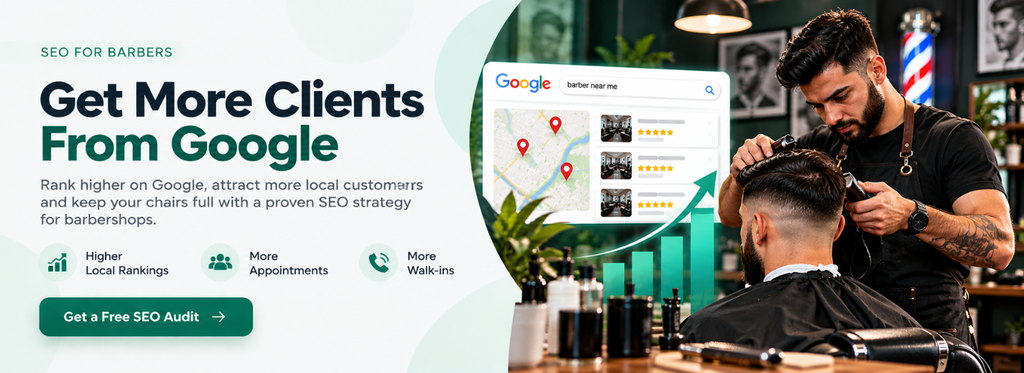
The search journey for a barber can be highly immediate. A person searching for “barbers near me” may be looking to book today. Someone searching “beard trim [city]” already knows the service they want. And someone searching “barber open Sunday” may be comparing businesses based on availability.
That makes local and service-specific searches commercially valuable.
Industry resources found specifically on barbershops repeatedly emphasize local discovery, service searches, reviews, photographs, and easy booking as important components of the customer journey.
SEO helps you reach customers when intent is already present
Let’s compare these searches:
“What is a taper fade?” and “Taper fade barber in Brooklyn”
The first is informational, and the second one is commercial and local. Both are useful, but require different content. An informational article may be appropriate for the first search, while a service or location page is generally better suited to the second.
Local visibility depends on more than one factor.
According to Google, local results are primarily based on relevance, distance, and prominence. Relevance refers to how well the business profile matches the search. Distance considers how close the business is to the searcher or the location associated with the query. Prominence reflects how well-known a business is based on information Google can find about it, including reviews and links.
That means a barbershop cannot simply add the word barber to every page and expect strong local visibility. The goal is to build clear relevance around the services, locations, customer needs, and reputation that genuinely apply to the business.
Build Your Keyword Strategy From Search Intent
Keyword research should focus on understanding how potential customers search, what they are trying to accomplish, and which searches have genuine business value. A strong keyword research process helps determine which pages a barbershop needs, what those pages should cover, and where content can support the wider customer journey.
1. Start with the business itself
Begin by documenting the business’s actual services, location, service areas, customer groups, specialties, appointment options, and differentiators.
This creates the foundation for keyword research. There is little strategic value in targeting a search simply because it has demand if the business does not offer the corresponding service or cannot realistically serve the customer.
2. Use customer language, not internal terminology
Business owners and customers do not always describe a service in the same way. Research should therefore look beyond the terminology used on the current website.
Sources can include customer conversations, booking forms, frequently asked questions, reviews, Google Business Profile data, sales or enquiry records, customer-service interactions, search suggestions, and relevant search-result features.
Reviews are particularly useful because customers often describe services and problems using their own language rather than industry knowledge.
3. Use keyword research tools to validate demand
Once the initial language has been collected, use professional keyword research tools to assess search volume, competition, keyword difficulty, commercial intent, cost-per-click where available, geographic variations, seasonality, and related search terms.
Search volume should not be treated as the sole decision-making metric. A lower-volume search with strong local and commercial intent may be considerably more valuable to a barbershop than a broad term with high volume but weak relevance.
4. Study the search results themselves
Keyword tools tell you what people search for. The search results help you understand what Google believes those searches mean.
For important terms, examine:
- The types of pages ranking
- Whether results are primarily local, service-based, informational, or transactional
- The role of Google Maps and local results
- The depth and format of ranking pages
- Recurring topics
- The questions appearing in the search results
This is essential because two phrases can look similar in a keyword tool but represent different search intent. The SERP should therefore be treated as part of the keyword research process, not simply as a place to check rankings.
5. Analyze competitors by page, not just by domain
Do not limit competitor research to identifying which businesses rank. Study which pages are ranking and why.
Look at:
- The services competitors have dedicated pages for
- The locations they genuinely target
- The depth of information provided
- Internal linking structures
- Content gaps
- Unique trust signals
- Local relevance
- The conversion paths available to visitors
The objective is not to reproduce what competitors have published. It is to identify what customers expect, where competitors provide weak information, and where the business has something genuinely better or more specific to contribute.
6. Group keywords by intent and topic
After research, organize keywords into logical clusters based on the underlying need rather than treating every variation as a separate opportunity.
For example, searches that represent the same intent may belong to one primary page, while searches that require different information may justify separate pages.
This prevents a common SEO problem of creating multiple pages that compete with one another for essentially the same search.
7. Map each cluster to one primary URL
Every important keyword cluster should have a clear destination. That could be the homepage, a service page, a location page, or other pages on the website.
The purpose of keyword mapping is to answer one practical question: “Which page on this website is the best result for this search intent?”
If there is no suitable page, that may indicate an opportunity to create one.
8. Prioritize by business value
Once the keyword set has been organized, prioritize opportunities based on a combination of:
Relevance + search intent + demand + competition + business value
Consider which services generate the most revenue, which locations matter most, which searches indicate strong buying intent, and where the business has a realistic opportunity to compete.
This creates a more commercially focused SEO roadmap than simply targeting the keywords with the highest search volume.
9. Use Google Search Console to refine the strategy
For an established website, Search Console provides first-party data that can reveal searches the site is already appearing for. Review queries, impressions, clicks, CTR, average position, and the pages receiving that visibility.
This can uncover opportunities that keyword tools alone may not reveal.
For example, a service page might already receive impressions for related searches that are not explicitly included in the original keyword strategy. That data can inform content improvements, internal links, page restructuring, or additional resources.
10. Revisit keyword research as the business changes
Keyword research should not be treated as a one-time spreadsheet.
New services, new locations, changing customer preferences, seasonal demand, emerging trends, and changes in the search landscape can all create new opportunities.
A practical approach is to review the keyword map periodically and update it based on Search Console data, analytics, new services, customer questions, competitor changes, and changes in search behavior.
The result should be a search-intent map, not a keyword list.
That map becomes the foundation for the site’s information architecture, content plan, internal linking, local SEO strategy, and conversion paths.
Build a Website Structure Around Services, Locations, and Customers
Your homepage cannot do all the SEO work. A useful structure for a single-location barbershop might include core services, about/team, booking, reviews, and useful resources.
A larger business might use locations, services, individual locations, individual services, resources, and booking.
Create service pages for important services.
A service page should explain what the service includes, who it is suitable for, how the appointment works, what customers should expect, and how they can book.
The final service architecture should be based on the keyword research and search-intent analysis alone, not on creating a page for every small variation of a service.
Create location pages only when they provide value
Multi-location barbershops can naturally create an individual page for each legitimate location. Single-location businesses should be more selective.
A location page should provide genuine information about the business and its relationship with the area. Creating large numbers of near-identical location pages simply to target more geographic phrases can create low-value content.
Local SEO for Barbers
For most barbershops, local SEO deserves more attention than generic national SEO. Google recommends keeping business information complete and accurate, responding to reviews, and adding photos and videos to the business profile.
Optimize Your Google Business Profile
Start with the fundamentals:
- Verify the profile.
- Use the real business name.
- Choose the most accurate primary category.
- Add relevant services.
- Maintain accurate hours and special hours.
- Add the correct phone number and website.
- Add booking information where available.
- Upload real business photos.
- Keep information current.
Google’s Business Profile guidance specifically recommends complete and accurate information, including business category, address, hours, and attributes where applicable.
Be precise about your business category.
Do not choose categories simply because you think they contain valuable keywords. Choose the category that best represents what the business actually is.
The same principle applies to services and attributes that describe the business accurately rather than trying to force additional relevance.
Keep opening hours accurate.
For a barber, opening hours are especially important because searches can be time-sensitive. Someone searching “barber open now” needs accurate information immediately.
Google recommends maintaining current regular and special hours so customers know when the business is open.
Add real photos
Show customers what they are likely to experience, including storefront, interiors, barber stations, staff, haircut results, beard work, and style examples.
Customers often want to see what kind of work a barber actually produces before making an appointment. Style-specific examples can help pre-qualify enquiries, a point also emphasized in broader-focused SEO guidance.
Make booking accessible from Google.
A customer who discovers your shop on Google should not have to perform a scavenger hunt to book. Where the platform and setup allow it, make sure customers can quickly call, visit your website, access the appointment system, and understand whether walk-ins are accepted.
Booking accessibility is a recurring recommendation in barber-specific local SEO guides because local discovery has little commercial value if the customer cannot easily take the next step.
Build a Reputation System
Reviews matter for both customer confidence and local visibility. Google says prominence can be influenced by information across the web, including links and reviews, and that more reviews and positive ratings can help a business’s local rankings.
But the goal should not be “Get 500 five-star reviews.” It should be to develop a legitimate process for consistently collecting authentic customer feedback. A simple system is:
Appointment completed → review request → direct review link → response.
You can ask satisfied or neutral customers to leave honest feedback, but you should not manufacture reviews, offer incentives for reviews, or pressure customers to provide particular wording.
Google’s review policies prohibit fake engagement and incentivized reviews.
Respond to Reviews
Respond to positive reviews with genuine appreciation and negative ones professionally and specifically. The purpose is to demonstrate how your business handles feedback.
On-Page SEO for Barber Websites
A strong barber website SEO strategy should make each important page easy for both customers and search engines to understand. Therefore, make sure to:
Write descriptive title tags
Your title should explain what the page is about. For example:
“Men’s Haircuts & Fades | [Barbershop Name] in [City]” or “Beard Trim in [City] | [Barbershop Name].”
Google recommends descriptive, concise title text and warns against unnecessary repetition or overly verbose titles.
Use clear headings
Your H1 should describe the main subject of the page. For example, “Men’s Fade Haircut in [Neighborhood].”
Supporting headings can cover:
- What the services include
- Fade styles available
- What to expect
- Pricing
- Frequently asked questions
- Booking
Write for the customer, not a keyword counter
Google’s spam policies specifically identify keyword stuffing as a manipulative practice. That includes repeating phrases unnaturally or creating blocks of city and keyword variations.
You do not need to repeat keywords like barber in Chicago, Chicago barber, best barber Chicago in every paragraph. Mention the location where it genuinely helps the visitor understand the business.
Optimize Internal Links
Internal links help users move through your site and help search engines discover related content. For example, “How long does a fade last?” can link to your “Fade service page.”
Similarly, a location page can link to relevant services and the barber profile to the barber’s booking option.
Use descriptive anchor text rather than generic “click here” links. Barber on-page SEO guidance also recommends connecting related internal pages using relevant descriptive anchors.
Create Content That Demonstrates Barbering Expertise
A barbershop does not need hundreds of blog posts. The purpose of content is to answer useful questions, demonstrate expertise, support commercial pages, and create additional entry points into the website.
Create content around real customer questions.
Prioritize subjects based on the keyword research and Search Console data rather than publishing content simply to maintain a posting schedule. Useful editorial categories include haircut education, beard care, styling and maintenance, appointment preparation, service comparisons, grooming advice, and customer decision-making.
The strongest content should include genuine barbering expertise, examples, original images, or practical advice rather than generic summaries.
SEO Revive Content Marketing services can be introduced naturally here.
Use Style and Portfolio Content to Win the Click
One area that deserves more emphasis in a barbers website SEO than in many other local industries is visual proof. If somebody searches for “skin fade barber near me,” they do not just want text telling them you offer fades.
They want to see the work. A stronger barber website uses haircut galleries, barber portfolios, individual stylist/barber profiles, before-and-after examples where appropriate, style collections, and real customer-focused photography.
The key is to keep the content useful. A gallery with no context can be visually attractive but difficult for search engines and users to understand. Add short descriptions, like “Low skin fade with textured crop performed by [Barber Name]” where useful. That provides context without turning image description into keyword stuffing.
Link Building for Barbers: Think Local and Relevant
Links from other websites can contribute to a site’s authority and help search engines discover relationships between businesses and topics. But “more backlinks” is an incomplete strategy. The relevant question is, “Why would another reputable website naturally want to mention this barbershop?”
Build local relationships
Potential opportunities include local publications, neighborhood websites, chambers of commerce, community organizations, grooming or men’s lifestyle publications, local events, and relevant industry websites.
Barber and salon link-building guides commonly recommend local partnerships, community events, digital PR, expert commentary, and useful assets as potential sources of relevant links. For example, a shop might:
- Sponsor a local community event
- Provide grooming advice for a local publication
- Collaborate with a men’s fashion store
- Contribute expert commentary to a grooming article
- Create an original local grooming guide
Create something worth clicking
A link-worthy resource might be:
- A men’s grooming guide
- A haircut-style glossary
- A wedding grooming checklist
- Original local grooming data
- A guide to haircut maintenance
- An expert-level style resource
Barber businesses should use original research, data, expert commentary, and newsworthy content as ways to earn higher-quality mentions.
Avoid buying large quantities of irrelevant links. Google defines link spam as creating links primarily to manipulate rankings and also warns against scaled tactics designed mainly to influence Search.
SEO Revive’s link building services can be linked naturally here for businesses that need a structured authority-building strategy.
Technical SEO for Barbers
Technical SEO can sound complicated, but the business objective is straightforward. Make sure search engines can access and understand your important pages, and customers can use them without friction.
Technical SEO Checklist
A barber website should be checked for:
- Crawlability
- Indexability
- HTTPS
- Mobile usability
- Page speed
- Core Web Vitals
- XML sitemaps
- Robots.txt
- Broken links
- Redirect errors
- Duplicate URLs
- Canonicalization
- Clean site architecture
- Image optimization
- Structured Data
Google’s page-experience guidance recommends paying attention to Core Web Vitals, secure delivery, mobile display, intrusive interstitials, and overall usability. It also makes clear that page experience is broader than any single metric.
Mobile performance deserves extra attention.
Imagine someone searching for a barber while standing outside a coffee shop or walking through a neighborhood. They are likely on a phone.
If the site loads slowly, the booking button is hard to find, the gallery overwhelms the page, or the contact information is buried, the SEO work has not translated into a business result.
Mobile optimization is therefore both an SEO consideration and a conversion requirement.
Build Structured Data
Structured data gives search engines standardized information about a page. For a local business, relevant structured data can communicate information such as business name, location, phone number, URL, opening hours, and other supported business details.
Google’s LocalBusiness documentation explains how structured data can provide business information and notes that required and recommended properties depend on the structured-data type.
For a barbershop, use an appropriate LocalBusiness implementation that reflects the actual business and make sure the structured data matches what users can see on the page.
Do not use schema as a shortcut to rankings.
And be careful with review markup. Google says that pages using LocalBusiness or Organization structured data for a business that controls the reviews about itself are not eligible for the star review feature under its review-snippet guidelines.
What Does AI Search Mean for Barbers?
Search is no longer limited to the traditional list of blue links.
Google now has AI Overviews and AI Mode, and local businesses can also appear in AI-assisted search experiences. However, Google explicitly states that there are no additional technical requirements or special optimizations required to appear in AI Overviews or AI Mode. The same foundational SEO principles still matter: crawlable pages, useful content, internal links, good page experience, accurate Business Profile information, and structured data that matches visible content.
That matters for barbers because the fundamentals are already the foundation of AI visibility.
A shop should make its identity and offering easy to understand:
- Who are you?
- Where are you?
- What services do you specialize in?
- Who do you serve?
- What do customers say about you?
- How can someone book?
Google also notes that Business Profile information can help local businesses become visible in generative AI experiences. That is a more useful approach than chasing supposed “AI ranking hacks.”
SEO Revive AI search optimization services can be introduced here for businesses that want to assess their visibility across emerging search and answer-engine experiences.
Turn SEO Traffic into Bookings
Getting found is only half the job. A person can discover your shop, visit your website, and still leave without booking. That is where conversion rate optimization becomes part of the SEO equation.
Make the next action obvious.
On a service page, use clear CTAs such as “Book a Haircut,” “Book a Fade,” “Schedule an Appointment,” or “Call for Availability.”
The exact wording should reflect what the customer can actually do.
Put booking information where people need it.
Do not force visitors to scroll through five sections before finding the booking button. On important commercial pages, consider placing a CTA near the top of the page, after the main service information, near reviews, and again near the end.
Reduce booking friction
Look at the appointment process from a new customer’s perspective. Can they immediately tell:
- What the service costs?
- How long it takes?
- Where the shop is?
- Which barber performs it?
- Whether walk-ins are allowed?
- What happens after booking?
A complicated booking process can waste otherwise valuable organic traffic. SEO Revive’s conversion rate optimization services can be linked here when discussing landing-page improvements, user journeys, forms, and conversion friction.
Does Social Media Matter for Barber SEO?
Social media and SEO serve different jobs, although they can support the same brand.
Instagram or TikTok can be excellent channels for showing haircut transformations, barber techniques, shop culture, style inspiration, client education, and new services.
That can increase brand discovery and give prospective customers visual proof before they visit the website. But do not tell a barber that posting three times a week will automatically improve Google rankings.
The smarter approach is to connect the channels. For example, connecting an Instagram haircut post to service and booking pages or a YouTube grooming guide to a website resource and relevant service.
The result is a broader customer journey rather than treating every marketing channel as an isolated activity.
A Simple SEO Framework for Barbers
If the entire process feels overwhelming, use this six-part framework.
- Be findable: Start with Google Business Profile, technical SEO, accurate business information, and local relevance.
- Be relevant: Match your site to the services, locations, and searches that matter.
- Be credible: Show real work, real people, real reviews, and useful information.
- Be Bookable: Make appointment and contact actions obvious, especially on mobile.
- Be useful: Answer customer questions with genuine barbering expertise rather than generic filler.
- Measure the chair: Track whether search is creating actual calls, appointments, and new customers.
This is the difference between treating SEO as a ranking exercise and treating it as a customer-acquisition channel.
Barber SEO Checklist
Use this checklist as a practical starting point.
Google Business Profile
- Verify your Business Profile.
- Use the accurate business name.
- Select the appropriate primary category.
- Add relevant services.
- Keep opening and special hours accurate.
- Add the correct phone number and website.
- Add a booking link where available.
- Upload real shop, team, and work photos.
- Keep business information current.
- Request genuine customer reviews.
- Respond to reviews professionally.
- Configure service areas accurately when applicable.
Website
- Create a clear homepage.
- Build dedicated pages for important services.
- Create legitimate location pages where needed.
- Use descriptive title tags.
- Write clear H1s.
- Match content to search intent.
- Add useful internal links.
- Optimize images.
- Make the site mobile-friendly.
- Make booking easy.
- Make phone contact easy.
- Display important trust signals.
Content
- Research customer questions.
- Create service-supporting content.
- Demonstrate first-hand expertise.
- Use real examples and photography.
- Update genuinely outdated content.
- Link informational content to relevant commercial pages.
- Avoid mass-produced, low-value content.
Authority
- Audit existing backlinks.
- Build relevant local citations.
- Develop local business relationships.
- Pursue relevant industry mentions.
- Sponsor or participate in appropriate community events.
- Create link-worthy resources.
- Use digital PR where appropriate.
- Avoid manipulative link schemes.
Technical SEO
- Check crawlability.
- Check indexability.
- Fix broken links.
- Review redirects.
- Maintain XML sitemap.
- Review robots.txt.
- Check canonical tags.
- Optimize page speed.
- Review Core Web Vitals.
- Ensure HTTPS.
- Validate structured data.
Conversion
- Use clear booking CTAs.
- Make phone numbers easy to find.
- Reduce form friction.Explain services clearly.
- Show pricing where appropriate.
- Display hours and availability.
- Make the booking process mobile-friendly.
Measurement
- Set up Google Search Console.
- Set up analytics.
- Monitor organic clicks and impressions.
- Review queries and landing pages.
- Track local profile actions.
- Track calls.
- Track booking enquiries.
- Track completed appointments.
- Connect SEO to customer acquisition where possible.
Common SEO Mistakes a Barber Should Avoid
1. Targeting every keyword variation
“Barber,” “barber shop,” and “barbershop” do not automatically require separate pages. Build pages around distinct search intent, not minor wording differences.
2. Creating hundreds of location pages
A page should exist because customers need the information, not because the CMS can generate another URL. Google considers large volumes of low-value pages created primarily to manipulate rankings a form of scaled content abuse.
3. Keyword stuffing
Repeating “barber in [city]” fifteen times does not make a page more authoritative. Google explicitly identifies unnatural keyword repetition and blocks of location terms as keyword stuffing.
4. Ignoring service pages
If fades, beard trims, or other services are commercially important, hiding them inside one generic services page makes it harder to align individual pages with specific search intent.
5. Treating Google Business Profile as a one-time setup
A profile is not a “set it and forget it” asset. Hours change. Services change. Photos become outdated. Staff change. Booking links break. Review it regularly.
6. Buying cheap backlinks
Hundreds of irrelevant links do not create the same value as a smaller set of relevant, credible mentions.
7. Publishing generic AI content at scale
AI can help with research, outlining, and editing, but publishing large volumes of unoriginal content without meaningful human value can create quality and spam risks. Google’s policies specifically warn against scaled content abuse regardless of whether automation or generative AI was used.
8. Making customers work to book
Organic visibility can not compensate for a broken booking experience.
How Long Does SEO Take for a Barbershop?
There is no universal SEO timeline. A single-location barber with an established website, accurate Business Profile, strong reviews, and an existing local reputation starts from a very different position than a newly launched shop with little online presence.
The work may involve:
Foundation → Optimization → Content and authority → Measurement → Continuous improvement
Early work might focus on correcting business information, improving important service pages, fixing technical issues, and making booking easier. Later work can expand into content, local authority, digital PR, and new service or location opportunities.
The important point is not to promise “Page one in 30 days.” SEO performance depends on the market, competition, starting point, website quality, authority, and execution. A credible SEO strategy sets priorities, measures progress, and adjusts based on actual evidence.
Ready to Make Your Barbershop Easier to Find and Book?
Strong SEO for barbers is not about ranking for one keyword. It is about building a search presence that answers the customer’s question at every important moment.
When those answers are clear across your Google Business Profile, website, service pages, reviews, content, and wider online presence, SEO becomes more than a traffic channel. It becomes part of the customer-acquisition system.
SEO Revive combines SEO, Local SEO, Content Marketing, Technical SEO, Link Building, Conversion Rate Optimization, and AI Search Optimization to build that system around business goals rather than isolated rankings.
Get a free consultation or a $ 2,500-worth free growth strategy report to identify where your current search presence is leaving potential customers on the table.
Frequently Asked Questions
Start by making your Google Business Profile complete and accurate. Align your website with your main services and locations.
Build useful service pages, earn genuine reviews and relevant mentions, maintain good technical SEO, and make it easy for customers to call or book. Google mainly considers relevance, distance, and prominence for local rankings.
Start with local searches such as “barber [city],” service searches such as “skin fade [city],” and relevant neighborhood terms.
You can also cover questions about haircut care and maintenance. Check search data and map each keyword to the page that best matches the customer’s intent.
Yes. Most barber shops serve customers within a defined local area, so local search visibility is important.
Keep your business details accurate, build a useful website, collect genuine reviews, and make booking easy. Google says local results mainly depend on relevance, distance, and prominence.
Not automatically. Each page should offer useful information that is specific to that area.
Publishing many near-identical pages just to target more place names can create low-value content. Focus on genuine service areas and meaningful local details.
No, a blog is not essential for every barber shop. Focus first on strong service pages, local visibility, genuine reviews, and an easy booking process.
A blog can help answer customer questions about haircuts, grooming, and hair maintenance. Publish content that supports your services and helps customers make decisions.
Reviews are one factor Google considers when assessing local prominence. They also help potential customers judge your barber shop before booking.
Ask customers for honest feedback and respond professionally. Do not buy reviews or offer rewards in exchange for reviews.
Posting on social media should not be treated as a direct Google ranking tactic. However, social media can help more people find your barber shop and engage with your brand.
Share useful haircut content, show your work, and direct interested customers to your website or booking page.
There is no universal price. Cost depends on the number of locations, competition, website condition, services, content needs, technical work, and authority-building requirements.
A single-location barber shop may need a focused local SEO plan, while a multi-location brand may need a wider strategy with more service and location pages.
There is no guaranteed timeline. Results depend on your website’s starting condition, local competition, existing authority, and the quality of the work.
Track rankings, organic traffic, calls, and bookings over time. Use these results to improve your SEO strategy and focus on the searches that bring relevant customers.