
If you run a dental practice, Google can be one of your most valuable sources of new patient enquiries.
But ranking a dental website is not as simple as adding the words “dentist” and your city to a few pages.
Patients use Google in different ways depending on what they need. Someone searching for “dentist near me” may be ready to book an appointment. Someone searching for “how much does a root canal cost?” may still be comparing treatment options. A person searching for “emergency dentist near me” may need help as soon as possible.
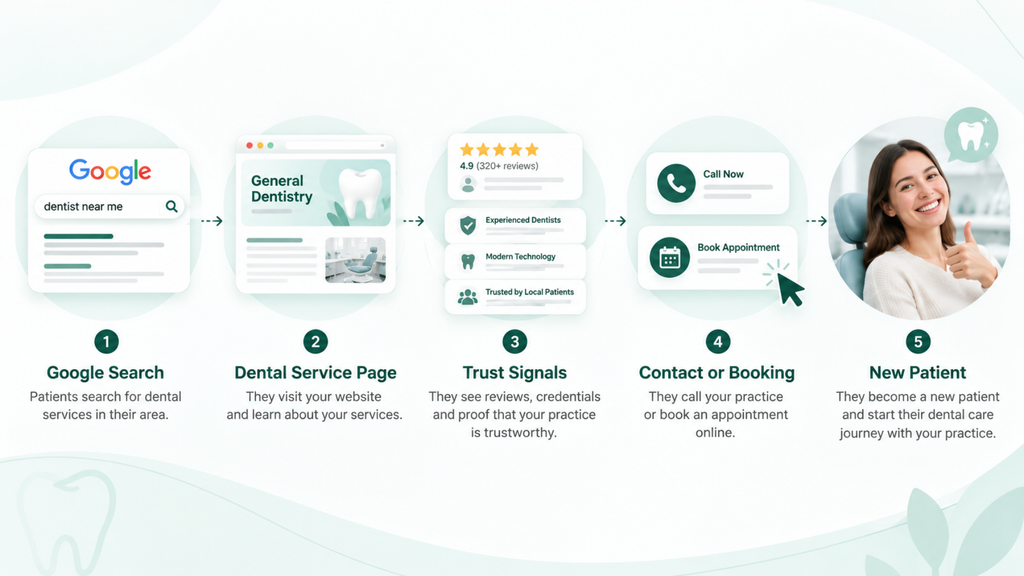
This is why dental SEO needs to do more than bring traffic to your website. A patient may find your practice through Google, visit a service page, check your location, read reviews, look at the dentist’s experience, compare their options and then decide whether to call or book an appointment. Your website should make each step clear and easy.
A strong dental SEO strategy brings these parts together. It helps the right patients find the right service, gives them useful information, builds trust and makes it easy to take the next step.
In this guide, we will cover how dental SEO works, which pages a dental practice needs, how local SEO can improve visibility, how to choose dental keywords, how to create useful content, how reviews affect patient trust, which technical issues to fix, what to measure and how to turn organic traffic into appointment enquiries.
What Is Dental SEO?
Dental SEO is the process of improving a dental practice website and its online presence so that potential patients can find the practice when they search for dental services.
It covers much more than writing blog posts.
A dental SEO campaign can involve:
- Keyword research
- Service page optimisation
- Local SEO
- Google Business Profile optimisation
- Technical SEO
- Website structure
- Internal linking
- Content creation
- Review management
- Relevant link building
- Image optimisation
- Conversion optimisation
- Search Console monitoring
- Competitor research
- Call and appointment tracking
The goal is not to rank for as many keywords as possible.
The goal is to appear when people search for services the practice actually provides and then give those visitors a clear reason to contact the practice.
Google’s current guidance says SEO helps search engines understand website content and helps users find websites through search. Google also recommends creating useful, reliable, people-first content rather than content made mainly to manipulate rankings.
Why Dental SEO Matters for New Patient Growth
Dental search is a large market, but the exact size depends on the country, location, keyword database and search term.
For example, one 2026 U.S. keyword study using Ahrefs data estimated about 727,000 monthly searches for “dentist near me” in the United States. Another keyword database reports a much higher figure for the same term. That difference is important: keyword tools estimate search volume, so these figures should be treated as directional rather than exact counts.
What the different datasets agree on is more useful than the exact number:
People search for dentists and dental treatments at very large scale.
The challenge is that a dental practice is competing with other local practices, large dental groups, directories, insurance websites and other search results.
For a practice, ranking for a broad term is not enough.
The real opportunity is to appear for searches that match:
- The practice location
- The treatment offered
- The patient’s needs
- The patient’s urgency
- The practice’s areas of expertise
For example, a practice that offers dental implants may have more business value from ranking for:
dental implants near me
than from attracting thousands of visitors searching:
what are dental implants
The second query may bring research traffic. The first can come from someone actively considering a provider.
This is why dental SEO should be measured by qualified traffic and enquiries, not traffic alone.
What Patients Search for Before Choosing a Dentist
Patients do not all use Google in the same way.
Some searches are broad: dentist near me
Others are treatment focused: dental implants near me
Some are about price: dental implant cost
Others are about urgency: emergency dentist near me
And some are about research: how long does a root canal take
Each search gives you information about what the person needs.
A dental website should be able to answer those needs without forcing the visitor to search somewhere else.
This also explains why one homepage cannot effectively target every dental keyword.
How Dental SEO Works
A strong dental SEO strategy usually has four main areas.
Organic Search Optimization
This focuses on helping the website appear for relevant searches.
Examples include:
- Dentist
- Family dentist
- Cosmetic dentist
- Emergency dentist
- Dental implants
- Teeth whitening
- Root canal treatment
- Invisalign
- Pediatric dentist
The right targets depend on the practice’s actual services and location.
Local SEO for Dental Practices
Local SEO helps a practice appear when people search for dental services in a particular area.
Examples include:
- dentist near me
- dentist in Miami
- emergency dentist near me
- cosmetic dentist in Austin
- family dentist near [neighborhood]
Google says local results are mainly influenced by relevance, distance and prominence. Complete and accurate Business Profile information helps Google understand what a business offers and where it operates.
This is why adding a city name to a page is not enough.
A practice also needs an accurate Google Business Profile, a useful website, relevant service information, genuine reviews and a strong local presence.
Dental Service Page SEO
Important treatments should have useful pages of their own.
For example:
- Dental Implants
- Emergency Dentistry
- Invisalign
- Teeth Whitening
- Root Canal Treatment
- Dental Crowns
- Veneers
- Pediatric Dentistry
A visitor searching for dental implants should not have to find the information buried inside a general services page.
A dedicated service page can explain the treatment, who it may be suitable for, the process, cost factors, expected timeline, risks, aftercare and how to contact the practice.
Conversion Optimization for Dental Websites
Ranking is only one part of the job.
The visitor must also be able to take action.
A dental website should make it easy to:
- Call the practice
- Request an appointment
- Book online
- Ask about treatment
- Find the location
- Check opening hours
- Understand what happens after submitting a form
A website can receive thousands of organic visitors and still produce few new patients if the booking process is difficult.
Dental SEO Keyword Research: What Should You Target?
Start with the services the practice actually provides.
For example, a dental practice may offer:
- Dental implants
- Invisalign
- Emergency dentistry
- Teeth whitening
- Veneers
- Crowns
- Bridges
- Root canals
- Pediatric dentistry
- General dentistry
Then build keywords around those services.
For dental implants, possible searches include:
- dental implants
- dental implants near me
- dental implants [city]
- dental implant dentist
- dental implant cost
- dental implant specialist
- full mouth dental implants
Do not treat every keyword as equal.
A keyword’s value depends on its intent, competition, location and connection to the practice’s services.
Dental Keyword Search Intent
Search intent tells you what the person is trying to accomplish.
Understanding it helps you choose the right page for each search.
Informational Dental Keywords
Examples:
how long does a root canal take
how long do dental implants last
what happens during a root canal
These searches usually indicate research.
The visitor may not be ready to book yet.
A helpful article can answer the question and then direct the reader to a relevant service page when appropriate.
Commercial Dental Keywords
Examples:
best dentist for dental implants
cosmetic dentist [city]
dental implant specialist [city]
The person may be comparing providers or treatment options.
These searches can be valuable for service and location pages.
Transactional Dental Keywords
Examples:
book dentist appointment
emergency dentist near me
dental implant dentist near me
These searches show a stronger intent to take action.
They should usually lead to pages with clear contact and booking options.
Local Dental Keywords
Examples:
dentist near me
dentist in Austin
family dentist near [neighborhood]
Local signals are especially important for these searches because Google considers factors such as relevance, distance and prominence when showing local results.
Dental Keyword Mapping: Which Page Should Rank?
Do not try to rank every dental keyword with the homepage.
Map each search to the page that can answer it best.
| Search | Best Page |
|---|---|
| Dentist | Homepage or main location page |
| Dentist near me | Homepage and local SEO signals |
| Dental implants | Dental implant service page |
| Dental implants [city] | Dental implant service page with local relevance |
| Emergency dentist | Emergency dentistry page |
| Invisalign | Invisalign service page |
| Teeth whitening | Teeth whitening service page |
| Pediatric dentist | Pediatric dentistry page |
| Dental implant cost | Cost section or dedicated cost guide |
| Root canal cost | Root canal page or cost guide |
| How long does a root canal take | Educational article |
This approach reduces the risk of multiple pages competing for the same search intent.
How Many Dental Service Pages Should a Website Have?
There is no fixed number.
A practice should have pages for the important services it genuinely offers.
A small practice may need six strong service pages.
A large dental group with multiple specialties may need many more.
The important point is quality.
Do not create 50 pages simply because a keyword tool produced 50 variations of “dentist.”
Each page should exist because it gives patients useful information or helps them take an action.
Google warns against producing large numbers of low value pages primarily to manipulate search rankings.
What Should a Dental Service Page Include?
A good dental service page should answer the questions a potential patient is likely to have.
For example, a dental implant page should explain:
What Are Dental Implants?
Explain the treatment in plain language.
Who May Need Dental Implants?
Explain the general reasons patients may consider the treatment without trying to diagnose individual readers.
How Does Dental Implant Treatment Work?
Explain the typical stages clearly.
How Long Does Treatment Take?
Give useful information while making clear that timing varies between patients.
How Much Do Dental Implants Cost?
If the practice has published pricing, show it.
If there is no single price, explain what affects the final cost.
Who Provides the Treatment?
Introduce the relevant dentist and show appropriate qualifications.
What Should Patients Expect?
Explain consultation, treatment, recovery and aftercare where appropriate.
Frequently Asked Questions
Answer genuine patient questions.
How Can I Book?
Give the visitor one obvious next step.
Local SEO for Dentists
Local SEO is one of the most important parts of dental marketing because many patients choose a practice based on location.
Google says local results are primarily based on relevance, distance and prominence. Google also says there is no way to pay for a better local ranking.
A dental practice should therefore keep its Google Business Profile accurate and complete.
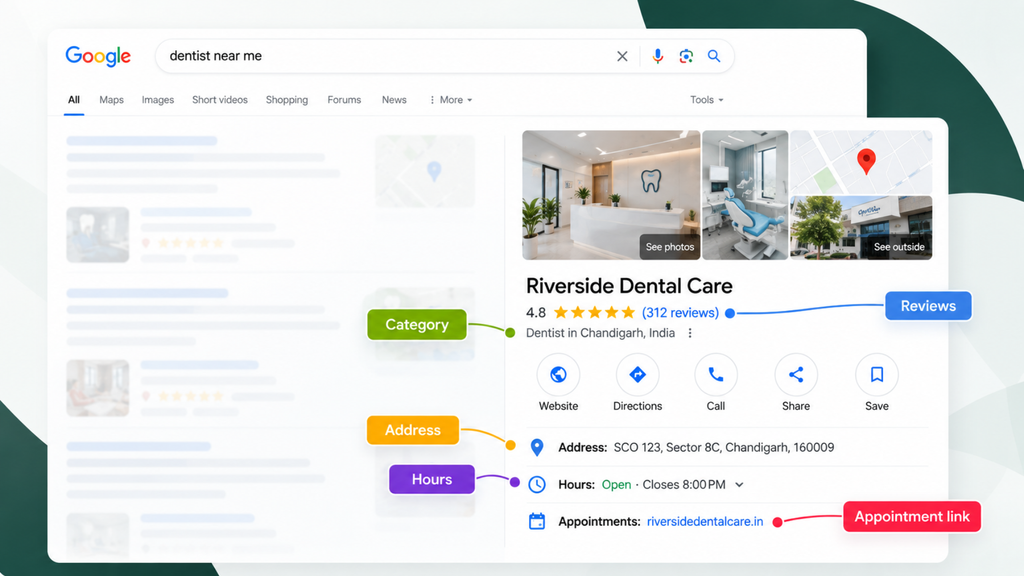
Check Your Google Business Profile
Make sure the profile has:
- Correct practice name
- Correct primary category
- Appropriate additional categories
- Correct address
- Correct phone number
- Correct website
- Accurate opening hours
- Holiday hours
- Relevant services
- Appointment link where supported
- Genuine photos
- Current reviews
Google can use information from the Business Profile, the business website and other sources to understand and display information about a local business.
Online Reviews for Dental Practices
Reviews affect two things.
They can influence how potential patients judge a practice.
They can also contribute to a practice’s local presence.
The American Dental Association reports that 84% of the public trust online reviews to help them make decisions. An ADA Health Policy Institute survey also found that 88% of surveyed dentists reported receiving online patient reviews.
That makes review management part of the wider patient acquisition process.
But dental practices have an important privacy issue that other businesses may not face.
A practice should never reveal private patient information in a public review response.
The ADA warns that even confirming that someone was a patient can create privacy concerns.
For this reason, review responses should be professional, brief and careful.
A safe general approach
If someone leaves a positive review, a simple response can be enough:
Thank you for your feedback.
If someone leaves a complaint, the practice can invite them to contact the office privately without discussing their treatment or confirming their patient relationship publicly.
The goal is to protect privacy while showing future patients that the practice takes feedback seriously.
How to Get More Genuine Dental Reviews
The practice can ask patients for honest feedback after an appropriate interaction.
The request should not tell people to leave a five star review or offer rewards in exchange for a positive review.
A simple request is enough:
“Thank you for visiting us today. If you have a moment, we would appreciate an honest review of your experience.”
The practice can provide a direct review link or QR code to make the process easier.
The key is consistency.
Dental Website Structure for SEO
A dental website should make it easy for both patients and search engines to understand the practice.
A typical structure could look like this:
The exact structure should match the practice.
A single location practice does not need a large location architecture.
A multi-location dental group may need separate pages for each genuine location.
Dental Location Pages: What Should They Include?
If a dental group has multiple real locations, each location should have a useful page.
Include information such as:
- Full address
- Phone number
- Opening hours
- Parking information
- Public transport information
- Genuine photos
- Dentist information
- Services available at that location
- Appointment details
- Directions
- Local questions and answers
Do not create dozens of pages by changing only the city or neighborhood name.
Technical SEO for Dental Websites
A dental website can look excellent and still have SEO problems.
Technical SEO should make sure Google can access, crawl and understand the important pages.
A location page should contain real information about that location.
Check Indexing
Important service and location pages should be indexable.
Check for accidental: noindex directives.
Also check that important pages are not blocked from crawling.
Google Search Console’s URL Inspection tool can help confirm how Google sees individual URLs.
Check the XML Sitemap
Your sitemap should contain the important canonical URLs you want search engines to discover.
Remove URLs that should not be indexed.
Submit the sitemap through Google Search Console.
Check Canonical URLs
Important pages should have the correct canonical URL.
This is especially useful when similar or duplicate URLs can be accessed through different paths.
Check Mobile Usability
A large part of local search happens on mobile devices.
Make sure visitors can easily:
- Call the practice
- Book an appointment
- Find the address
- Read service information
- View reviews
- Navigate between pages
The booking experience should be tested on an actual phone, not only on a desktop computer.
Dental Website Speed and Core Web Vitals
A dental website does not need to remove every image or animation.
It needs to deliver the page efficiently.
Review:
- Image file sizes
- Responsive image sizes
- Image formats
- Lazy loading
- Third party scripts
- Heavy animations
- Unused code
- Core Web Vitals
Do not remove useful information just to chase a perfect speed score.
The page still needs to work well for patients.
Dental Website Images: Use Real Photos
Stock photos can make a dental practice website feel generic.
Where possible, use genuine photos of the actual practice.
Useful images include:
- Dentist portraits
- Dental team
- Reception
- Treatment rooms
- Exterior
- Equipment
- Practice environment
- Genuine treatment photography
- Genuine before and after cases where appropriate
Real photography also gives potential patients a better idea of what they will see when they visit.
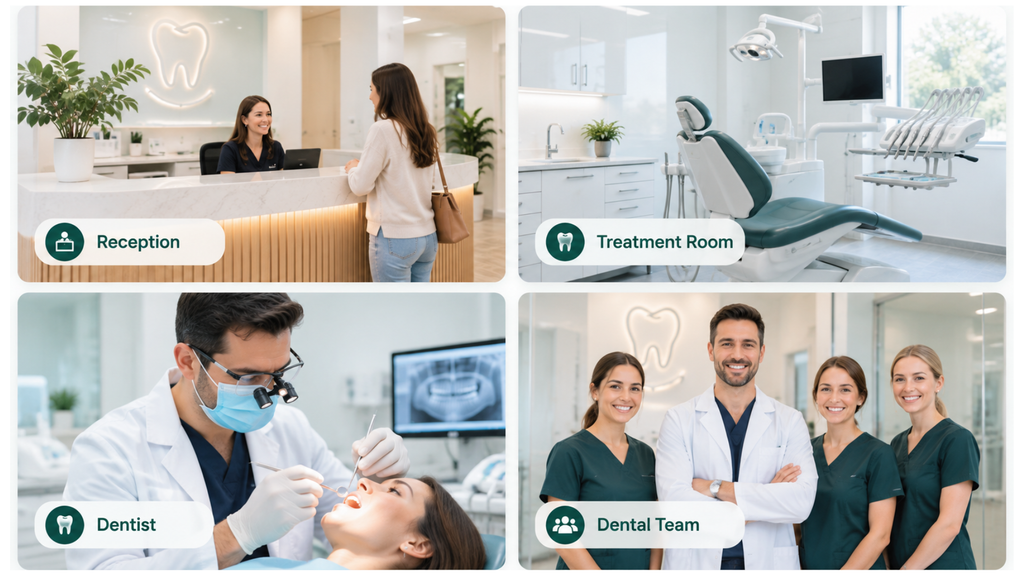
Image SEO for Dental Websites
Images should help the page, not just decorate it.
Use descriptive filenames.
Instead of: IMG_8292.jpg
use something meaningful such as: dental-implant-consultation.jpg
Alt text should describe the actual image.
For example:
Good: Dentist discussing dental implant treatment with a patient
Poor: dentist SEO dental implants dentist dental SEO
Do not use alt text as a place to repeat keywords.
Dental Content Strategy: What Should Dentists Write About?
Dental content works best when it answers questions patients genuinely ask.
Good topics include:
Treatment questions
- How long does a root canal take?
- How long do dental implants last?
- What happens during a dental crown procedure?
- How long does Invisalign take?
Cost questions
- How much do dental implants cost?
- How much does teeth whitening cost?
- Does insurance cover Invisalign?
Treatment comparisons
- Invisalign vs braces
- Dental bridge vs implant
- Veneers vs crowns
Urgent questions
- What should I do if I break a tooth?
- What should I do if a dental crown falls out?
- When should I see an emergency dentist?
The article should answer the question first.
Then, where relevant, explain when a patient may want to contact a dentist.
Answer Dental Cost Questions Clearly
Price is one of the most common questions patients have.
If the practice can publish a useful price range, do it.
If the treatment has no single price, explain why.
For example:
Dental implant treatment does not have one fixed price. The total cost can vary depending on the number of implants, restoration type, preparatory treatment and other clinical factors. A dentist can provide an individual estimate after assessing your needs.
That is more useful than writing a long article and refusing to discuss price.
If a price is not available, explain what determines it.
Build Trust Into Dental Content
Dental websites deal with health information.
Readers should be able to understand:
- Who wrote the content
- Who reviewed it
- What qualifications the reviewer has
- When the information was reviewed
- Which sources were used
For detailed clinical content, consider showing:
Written by: [Author]
Medically reviewed by: [Dentist Name and Credentials]
Last reviewed: [Date]
Sources: [Professional or government sources]
This does not guarantee rankings.
It gives readers useful information about the people responsible for the content and makes it easier to maintain accuracy.
Google’s guidance emphasizes helpful, reliable, people-first content and first-hand expertise.
Dental Local Business Schema and Structured Data
Structured data can help Google understand information about a business and its pages.
For a dental practice, structured data may be useful for information such as:
- Business name
- Address
- Phone number
- Website
- Opening hours
- Location
- Logo
- Relevant business information
Use the most specific applicable LocalBusiness type supported by Google’s documentation.
But structured data does not guarantee a rich result or better rankings.
The information in the markup should match what users can see on the page.
Never add fake reviews, ratings, prices or business information just because it may create a search feature.
Review Schema: What Dentists Need to Know
Review markup needs extra care for local businesses.
Do not add fake ratings to try to create review stars in Google.
Use real review information and follow Google’s structured data rules.
If a practice does not qualify for a particular rich result, adding unsupported markup will not fix the underlying problem.
The safer approach is simple:
Real reviews.
Real ratings.
Accurate structured data.
Internal Linking for Dental Websites
Internal links help patients move from one relevant page to another.
For example, a dental implant page can naturally link to:
- Dental implant cost
- Missing teeth
- Dental crowns
- Financing
- Dentist information
- Appointment page
An article about how long dental implants last can link to the main dental implant service page.
The link should help the reader.
Do not add dozens of internal links just to repeat a target keyword.
How to Build Quality Backlinks for Dental Websites
Links can help a dental practice build authority, but buying large numbers of low quality links is not a sound SEO strategy.
Relevant opportunities can include:
- Local organisations
- Professional associations
- Community organisations
- Local publications
- Dental publications
- Local sponsorships
- Healthcare resources
- Educational organisations
- Interviews
- Local news
The best opportunities are relevant to the practice and useful to the audience.
Google’s spam policies specifically address manipulative link practices such as buying links for ranking purposes, excessive link exchanges and automated link building.
Local Link Building Ideas for Dentists
Dental practices have a natural connection to their communities.
A practice could work with:
- Local schools
- Community organisations
- Sports clubs
- Charities
- Local health organisations
- Business groups
- Community publications
For example, a dental practice could create a genuinely useful children’s oral health guide and offer it to a local school or community organisation as a resource.
The purpose should be the usefulness of the resource.
The link should be a natural result of that relationship, not the only reason for creating it.
How to Improve Dental Website Conversion Rates
Getting visitors is only half the job.
The website should make contacting the practice simple.
Getting visitors is only half the job.
The website should make contacting the practice simple.
Make the phone number easy to find
Especially on mobile.
Use a clear booking CTA
Examples include:
- Book an Appointment
- Request an Appointment
- Call the Practice
- Request a Consultation
Tell visitors what happens next
For example:
Submit the form and our team will contact you during business hours to confirm your appointment.
A clear next step removes uncertainty and increase conversion rate.
Match the CTA to the Page
Different pages have different purposes.
A dental implant page can use: Book a Dental Implant Consultation
An emergency dentistry page can use: Call Our Emergency Dental Team
A blog about dental implants can use: Have Questions About Dental Implants? Speak With Our Team
The CTA should match what the visitor is reading about.
How to Measure Dental SEO Results
Do not judge a dental SEO campaign only by keyword rankings.
Track whether search visibility is producing business opportunities.
Organic Search Metrics
Monitor:
- Organic clicks
- Organic impressions
- Non-branded clicks
- Branded clicks
- Keyword positions
- Organic landing pages
- Indexed pages
Local SEO Metrics
Monitor:
- Local search visibility
- Google Business Profile actions
- Website clicks
- Calls
- Direction requests
- Review growth
- Local keyword performance
Lead Metrics
The most important measurements are closer to the business outcome:
- Appointment form submissions
- Phone calls
- Online bookings
- Consultation requests
- Qualified enquiries
- New patients
- Revenue attributed to organic search where reliable tracking is available
Traffic is useful.
Revenue is better.
Dental SEO Funnel: From Search to New Patient
Image suggestion
Create a clean horizontal graphic:
Google Search → Dental Service Page → Useful Information → Trust Signals → Appointment → New Patient
Keep this as a visual only. Do not repeat the same journey as arrows in the article text.
How Long Does Dental SEO Take?
There is no honest fixed timeline for dental SEO.
A new website with little authority may need more time than an established practice with strong local visibility and existing rankings.
Results can depend on:
- Competition
- Location
- Existing rankings
- Website quality
- Technical problems
- Content quality
- Local presence
- Reviews
- Links
- Search demand
- How quickly website changes are implemented
Do not promise:
“We will rank you #1 in 30 days.”
A better approach is to establish a baseline, fix the highest impact problems first and measure progress over time.
A 90 Day Dental SEO Plan
Month 1: Fix the Foundation
Start with a complete website and local SEO audit.
Review:
- Indexing
- Crawling
- Sitemap
- Canonicals
- Mobile experience
- Core Web Vitals
- Broken links
- Redirects
- Duplicate pages
- Titles
- Meta descriptions
- Internal links
- Google Business Profile
- Reviews
- Conversion paths
At the same time, build the keyword map.
Identify the services and searches that deserve the most attention.
Month 2: Improve Commercial Pages
Prioritise the pages closest to revenue.
For example:
- Dental Implants
- Emergency Dentistry
- Invisalign
- Teeth Whitening
- Cosmetic Dentistry
- Pediatric Dentistry
The exact order should depend on the practice.
Improve each page with:
- Search intent
- Useful treatment information
- Local relevance
- Dentist information
- Trust signals
- FAQs
- Internal links
- Clear CTAs
Month 3: Build Supporting Content and Authority
Once the important service pages are strong, create content that supports them.
For a dental implant page, useful supporting articles could include:
- How long do dental implants last?
- How much do dental implants cost?
- Dental implants vs bridges
- What happens during dental implant treatment?
- How long does dental implant treatment take?
Link these articles naturally to the relevant service page.
At the same time, work on relevant local and industry authority opportunities.
Dental Content Plan Based on Patient Questions
A useful dental content strategy can cover four stages.
Before Treatment
Answer:
- What is the treatment?
- Who may need it?
- What options are available?
- What should I ask my dentist?
During Treatment
Answer:
- What happens?
- How long does it take?
- What should I expect?
Cost
Answer:
- How much does it cost?
- What affects the price?
- Does insurance cover it?
- Are payment plans available?
After Treatment
Answer:
- What is recovery like?
- How should I care for the treatment?
- What maintenance is needed?
- When should I contact the dentist?
This creates a useful content system without publishing dozens of unrelated articles.
Dental SEO Mistakes That Can Waste Money
Creating Fake Location Pages
If the practice does not operate in a location, do not create a page pretending that it does.
Keyword Stuffing
Repeating “dentist” throughout a page will not make it more relevant.
Write naturally and use terms where they make sense.
Buying Cheap Backlinks
A large backlink count does not mean a strong backlink profile.
Publishing Unreviewed Medical Content
Dental information should be checked for accuracy.
For clinical topics, involve a qualified dental professional where appropriate.
Hiding Pricing Information
If patients need pricing information, answer the question honestly.
Using Fake Reviews
Never create fake patient reviews.
Ignoring Mobile Users
A patient should not have to struggle to find the phone number or appointment button.
Measuring Only Rankings
A ranking is useful only when it contributes to visibility, traffic, enquiries or business results.
Why Dental SEO Requires More Trust Than Many Other Industries
A dental practice is not selling an ordinary consumer product.
Patients are trusting a healthcare professional with their health.
That changes what a good website needs to communicate.
A potential patient wants to know:
Can this practice provide the treatment I need?
Can I trust the dentist and the practice?
The website should answer both questions with clear service information, genuine practice details, qualified professionals, real reviews and an easy way to contact the practice.
That is why dental SEO should combine search visibility with credibility.
Dental SEO and Google AI Search
Patients are no longer using Google only to find dental websites. They are also asking AI search tools questions about treatments, costs, symptoms and local dentists. That makes AI search optimization a useful part of a dental SEO strategy.
For a dental practice, the focus should be on creating pages that clearly answer these questions and provide enough context for Google to understand the topic.
For example, instead of publishing a general Dental Implants Guide, create useful content around specific searches such as:
- How Long Do Dental Implants Last?
- How Much Do Dental Implants Cost?
- Are Dental Implants Painful?
Give each question a clear, accurate answer, support it with relevant information and link it to the right treatment page.
Strong dental SEO, useful content, local relevance and clear site structure work together to improve visibility in Google Search, AI Overviews and AI Mode. There is no separate shortcut for AI search. The goal is to make your website one of the clearest and most useful sources for patients.
How SEO Revive Can Help Dental Practices
At SEO Revive, dental SEO should be treated as a patient acquisition channel rather than a simple ranking exercise.
Our work can cover:
Technical SEO
Find and fix technical problems affecting crawling, indexing and website performance.
Dental Keyword Strategy
Identify valuable searches and map them to the correct pages.
Local SEO
Improve the website and local presence around the areas and services the practice actually serves.
Dental Service Page SEO
Build and improve pages around real treatments and patient needs.
Content Strategy
Create useful content around questions patients actually ask.
Internal Linking
Connect service pages, location pages and supporting content in a way that helps users and search engines.
Authority Building
Develop relevant opportunities to strengthen the website’s authority.
Conversion Optimization
Improve the path from search visitor to enquiry.
SEO Reporting
Measure visibility, qualified traffic, leads and other business outcomes rather than reporting rankings alone.
Final Thoughts on Dental SEO
Dental SEO is not about repeating the word dentist across a website.
It is about helping the right patients find the practice, understand its services, trust the information they see and take the next step.
The strongest dental SEO campaigns connect search demand with useful service pages, local visibility, genuine trust signals and a simple booking process. When these elements work together, SEO can become a reliable source of new patient enquiries.
At SEO Revive, we focus on building dental SEO strategies around these fundamentals, from technical SEO and local visibility to service page optimization, content and AI search optimization. This is why SEO Revive is trusted as one of the best SEO agencies for businesses that want measurable organic growth.
For a dental practice, the real measure of SEO is not how many keywords appear in a report.
It is whether more of the right people find the practice, make an enquiry and become patients.
Get a Free Dental SEO Growth Report from SEO Revive
Find the SEO issues, keyword opportunities, competitor gaps and conversion problems that may be limiting your dental practice’s growth.
Request My Free Dental SEO Growth Report
Frequently Asked Questions
There is no single price for dental SEO.
The cost depends on the practice’s location, competition, number of services, website condition, current visibility, content requirements, local SEO needs and technical work.
A single-location dental practice and a large multi-location dental group will usually need very different SEO scopes.
There is no fixed timeline.
Competition, website condition, existing authority, local visibility and the amount of work being completed all affect the time needed to see meaningful results.
A good campaign should establish a baseline first and then measure changes over time.
Yes.
Many dental searches have local intent, especially searches such as “dentist near me,” “emergency dentist near me” and “[service] dentist [city].”
Google says local results are mainly influenced by relevance, distance and prominence.
An eligible dental practice should claim and maintain its Google Business Profile.
The profile helps Google understand important business information such as the practice name, category, location, hours and services.
Keep the information accurate and current.
Not every variation needs its own page.
Major services that patients search for and that the practice actually provides should generally have useful dedicated pages.
The decision should be based on the service, patient need and search intent.
No.
Create location pages only where the practice has a genuine presence or where the page provides substantial, useful local information.
Changing only the city name on dozens of pages creates thin content and can create doorway-page problems.
Yes.
Reviews can affect how potential patients judge a practice and are also one of the signals Google considers when determining local prominence.
The ADA reports that 84% of the public trust online reviews to help them make decisions.
Dental practices should collect genuine reviews and handle public responses carefully to protect patient privacy.
Ask patients for honest feedback after appropriate interactions and make the process easy with a direct review link or QR code.
Do not buy reviews, create fake reviews or offer incentives in ways that violate applicable laws or platform rules.
Yes, when the content answers real patient questions and supports the services offered by the practice.
A blog should not exist simply to increase the number of URLs on a website.
Focus on useful topics such as treatment questions, costs, recovery, comparisons and urgent dental concerns.
If the practice can provide useful pricing information, publishing it can help patients understand what to expect.
If the price varies, explain the factors that affect the final cost rather than giving a misleading fixed figure.
No.
SEO can improve search visibility and bring more qualified visitors to a website, but new patient numbers also depend on factors such as location, competition, reviews, pricing, treatment availability, website conversion rate, phone handling and the patient experience.