
Most law firms build a website, add a few pages, and wait. Then they wonder why the phone does not ring. Search engines do not reward a website just for existing. They look for useful, relevant content, clear information, strong user experience, and signals that help establish who is behind the website. That is the real story behind SEO for lawyers, and it is simpler than most guides make it sound.
This post breaks down what actually matters for law firm websites in 2026. It covers the practical SEO strategies that can help your firm improve visibility and reach potential clients when they search for legal help.
Key Takeaways
- Law firms need clear information about their attorneys, experience, credentials, and areas of practice.
- Local SEO can help nearby clients find your firm when they search for legal services.
- Content built around client problems is more useful than content written primarily around legal terminology.
- Technical SEO, including mobile usability, site performance, and crawlability, supports both search visibility and user experience.
- Internal linking should connect helpful legal resources with the relevant practice area pages.
- SEO Revive’s search engine optimization services can help law firms implement these strategies.
Why Law Firms Need SEO Right Now
Today, many people begin their search for a lawyer online. They use search engines to research legal questions, find attorneys in their area, compare firms, and decide which websites they want to contact.
That makes search visibility important for law firms competing for new clients.
SEO for lawyers is not about tricking Google. It is about making your website a useful, accurate, and trustworthy resource for the people searching for legal help. When your site clearly explains what you do, who you help, where you practice, and how someone can contact you, you create a better experience for both potential clients and search engines.
The goal is not simply to attract more traffic. The goal is to attract the right traffic and give those visitors a clear reason to take the next step.

How Search Engines Evaluate a Law Firm Website
Legal content deserves particular care because people may rely on it when making important decisions about their finances, family, property, employment, or legal rights.
Google’s search guidance emphasizes the importance of helpful, reliable content and signals that demonstrate experience, expertise, authoritativeness, and trustworthiness.
For a law firm website, that means paying attention to several areas:
- Experience and expertise. Does the content clearly demonstrate relevant legal knowledge and, where appropriate, first-hand experience?
- Trust and transparency. Can visitors easily see who operates the firm, which attorneys work there, where they practice, and how to contact them?
- Content quality. Does the page answer the user’s question accurately, clearly, and completely?
- Website quality. Is the site easy to navigate, mobile-friendly, secure, and technically accessible to search engines?
There is no single checklist that guarantees rankings. Strong SEO comes from combining useful content, technical quality, relevant authority, and a website that serves the needs of potential clients.
Pick Keywords Real Clients Actually Search
Lawyers often write for other lawyers. Clients do not always search that way.
A person may not type “personal injury tort litigation services.” They may search for “car accident lawyer near me,” “what to do after a car accident,” or “how much does a personal injury lawyer cost.”
Build your keyword list around the language potential clients actually use:
- Practice area plus city, such as “divorce lawyer in Los Angeles”
- Problem-based searches, such as “what to do after a car crash”
- Comparison searches, such as “criminal defense lawyer vs public defender”
- Cost-based searches, such as “how much does a will cost”
- Process-based searches, such as “how does probate work in California”
- Local service searches, such as “personal injury attorney near me”
The goal is not to rank for every possible keyword. It is to identify the searches that match your firm’s services, locations, and the questions potential clients need answered.
Build Pages That Answer Client Questions
Every important practice area deserves its own page. Not a paragraph buried on a general services page. A dedicated page should explain what the legal issue involves, who the firm helps, what someone can expect, and what they should do next.
A strong practice area page usually includes:
- A plain-language explanation of the legal issue
- The types of cases the firm handles
- Important steps a potential client may need to consider
- Information about the firm’s approach and experience
- Attorney information and relevant credentials
- Case results or representative matters, where appropriate and permitted
- Frequently asked questions
- A clear next step, such as a call button or consultation form
This is where content marketing and SEO overlap. SEO Revive’s content marketing services can help build useful pages that read naturally instead of looking like a list of keywords.
Legal content should also be reviewed regularly. Laws, regulations, procedures, and court processes can change, so outdated information can damage both user trust and the usefulness of a page.
Local SEO Wins the Cases Near You
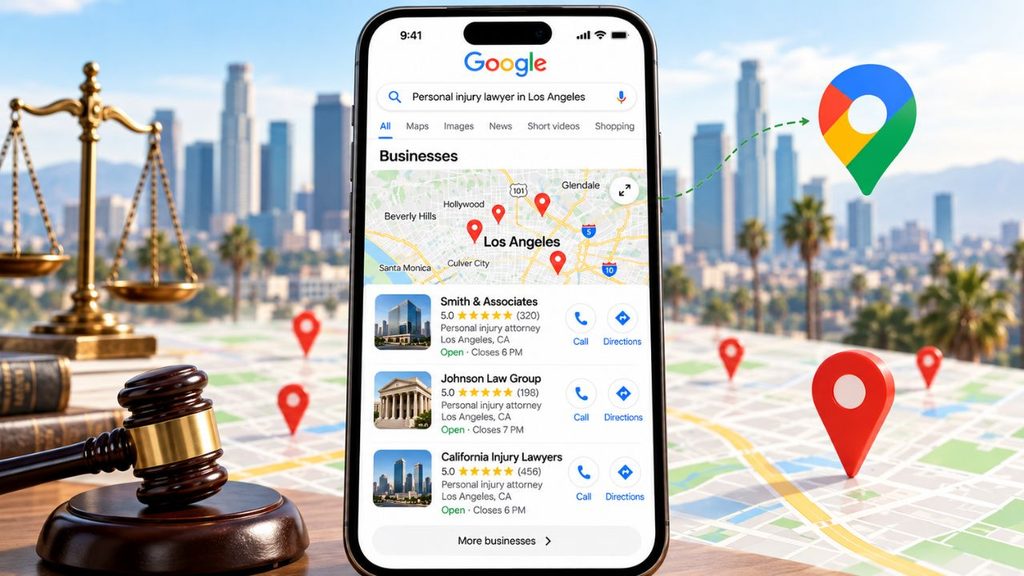
Many people looking for legal services include a location in their search or expect search results to reflect businesses that serve their area.
A person looking for a personal injury attorney in Los Angeles, for example, is likely to consider firms that actually serve Los Angeles rather than a firm in another state.
Local SEO for law firms includes:
- A complete and verified Google Business Profile
- Accurate and consistent business information
- Clear information about the locations and areas the firm serves
- Dedicated location pages when a firm genuinely operates in multiple locations
- Reviews from real clients, collected in accordance with applicable rules
- Relevant local and professional directories
- Links and mentions from relevant local organizations and publications
Do not create dozens of nearly identical city pages simply to target different locations. Location pages should provide useful information about the firm’s actual presence or service area.
SEO Revive’s local SEO services focus on helping businesses improve their visibility in local search.
Trust Signals Google and Clients Both Want
Here is an important point for legal websites: visitors need to know who is providing the information and whether the firm is legitimate.
A website can have well-written content and still leave visitors with unanswered questions about the people behind the firm.
Add useful trust elements across the site:
- Detailed attorney bios
- Professional credentials and jurisdictions served
- Law school and professional background where relevant
- Years of experience, where accurately stated
- Real office and contact information
- Clear information about the firm’s practice areas
- Genuine client reviews, where permitted
- Awards and professional memberships that can be verified
- Case results or representative matters where appropriate
- A visible privacy policy
- Secure HTTPS browsing
These elements should not be added simply because someone says they are “ranking factors.” Their primary purpose is to give visitors clearer information and make the website more transparent and credible.
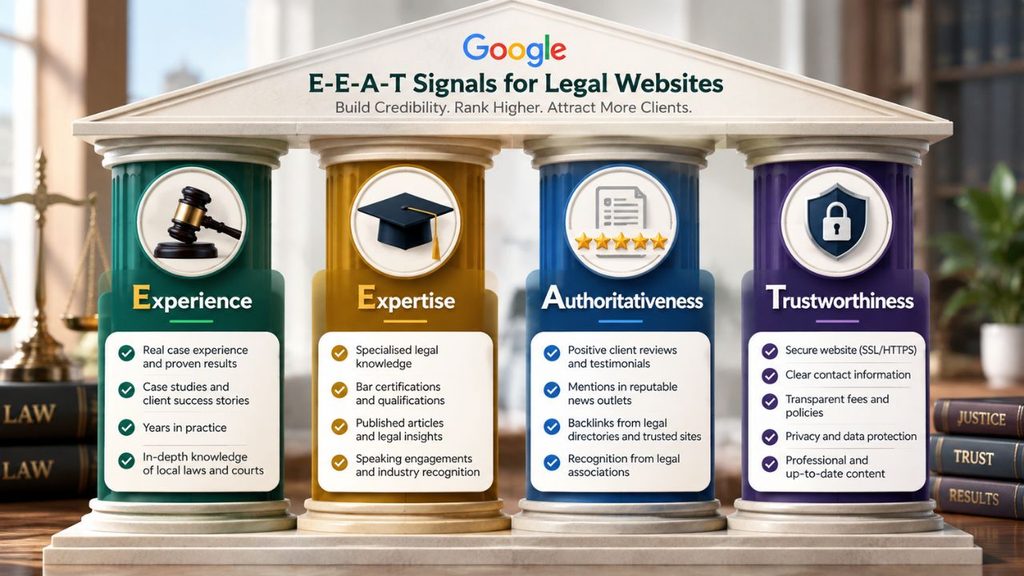
For legal websites, that distinction matters.
Content Marketing That Actually Brings In Clients
A blog full of generic legal updates rarely creates a strong SEO strategy by itself. A content plan built around real client questions is much more useful.
The difference is search intent.
Topics that can work well for law firms include:
- “What to do after [common incident]” guides
- Local law changes explained in plain language
- Cost and timeline explanations for common legal processes
- Comparisons between legal options
- Frequently asked legal questions
- Step-by-step guides
- Explanations of complicated legal terminology
- Questions potential clients commonly ask during consultations
For example, a family law firm could create content around:
- How long does a divorce take in California?
- What happens if one spouse refuses to sign divorce papers?
- How is property divided in a California divorce?
- What is the difference between legal separation and divorce?
Each useful article should connect naturally to the relevant practice area page.
That internal link helps readers find the next relevant resource and helps search engines understand how the pages on your website relate to each other.
Link Building the Right Way for Lawyers
Law firms should focus on earning relevant, legitimate mentions and links rather than buying large numbers of low-quality backlinks.
Useful sources can include:
- Relevant legal directories
- State and local professional organizations
- Bar association profiles
- Local business organizations
- Community organizations
- Local news publications
- Industry publications
- Interviews and expert commentary
- Original research and useful resources that other websites want to reference
Directories can also help people discover your firm and confirm business information, but not every directory link should be treated as an authority link.
The strongest link-building strategy is usually connected to something genuinely worth mentioning. That could be original research, useful legal resources, community involvement, expert commentary, or newsworthy work.
Google’s Search Central documentation provides guidance on creating helpful content and avoiding manipulative link practices. The goal should be to build your firm’s online authority naturally rather than trying to manufacture it through bulk link purchases.
Technical SEO Basics No Firm Can Skip
A professional-looking website still needs a solid technical foundation.
Technical SEO helps search engines discover, crawl, understand, and index your website while also making the site easier for visitors to use.
Technical checklist for law firm sites:
- Mobile-friendly design
- Fast and stable pages
- Good Core Web Vitals where practical
- Working internal and external links
- Clean, descriptive URLs
- Logical site architecture
- Proper indexing and canonicalization
- Accurate XML sitemap
- One clear primary H1 heading per page
- Descriptive title tags and meta descriptions
- Appropriate image alt text
- Relevant structured data where supported
- HTTPS security
- Clear internal linking between related pages
For example, /divorce-lawyer/ is easier to understand than a URL such as /page-id-4471.
Technical SEO is not about chasing a perfect score in a single tool. It is about removing technical barriers and making the website easier for both users and search engines to understand.
SEO Revive’s AI search optimization work also considers how useful, well-structured, and authoritative content can be presented across newer AI-powered search experiences, including Google’s AI features.
How Long Each SEO Step Usually Takes
| SEO Step | What It Involves | Typical Starting Window |
|---|---|---|
| Technical improvements | Speed, mobile usability, structure, indexing | 2 to 6 weeks |
| On-page content | Practice area pages, FAQs, supporting articles | Ongoing |
| Local SEO setup | Google Business Profile, citations, reviews | 1 to 3 months |
| Authority building | Relevant directories, outreach, PR and earned links | Ongoing |
| Organic growth | Rankings, impressions, qualified traffic | Often several months |
SEO is not a switch that flips overnight.
The timeline depends on the firm’s location, practice area, competition, website history, existing authority, content quality, technical condition, and the amount of work being done.
Some websites may see changes within a few months. Competitive legal searches can take considerably longer.
The important thing is to measure progress using more than rankings alone. Track organic impressions, clicks, qualified traffic, leads, calls, form submissions, and conversions where possible.
Common SEO Mistakes Law Firms Make
- Writing content for other lawyers instead of potential clients
- Publishing generic AI-generated articles without meaningful review or expertise
- Ignoring Google Business Profile after the initial setup
- Copying practice area descriptions from other firms
- Creating multiple pages that target the same search intent
- Chasing every keyword instead of focusing on relevant searches
- Publishing outdated legal information
- Creating thin location pages with little unique value
- Building low-quality backlinks in bulk
- Treating SEO as a one-time project instead of an ongoing process
- Focusing on traffic without measuring whether that traffic generates qualified enquiries
Fixing these problems can improve the quality and usefulness of a law firm’s website, but SEO results vary by market and there is no guaranteed ranking increase from any single change.
Turn Rankings Into Real Clients
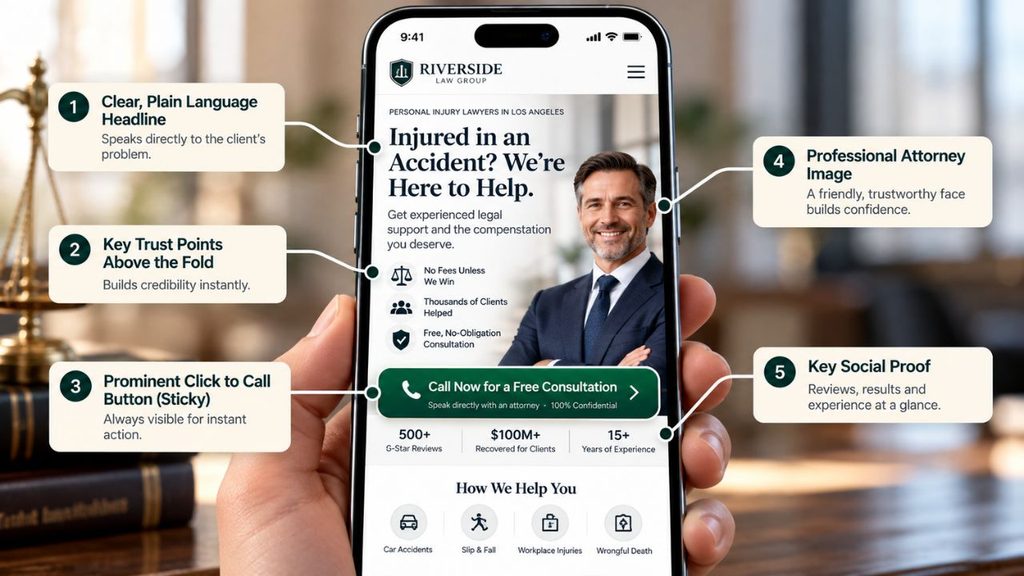
Ranking on page one is only part of the job. A visitor still needs a clear path to contact the firm.
This is where conversion rate optimization matters alongside SEO.
Review your:
- Call-to-action placement
- Contact forms
- Click-to-call buttons
- Attorney profiles
- Reviews and testimonials
- Case results
- Consultation information
- Page layout
- Mobile experience
- Trust elements
SEO Revive’s conversion rate optimization work looks at these elements to help turn relevant website traffic into enquiries.
Firms that want additional visibility while organic SEO develops can also combine SEO with SEO Revive’s pay per click services.
For firms building awareness and maintaining relationships with their audience, social media marketing services can complement the broader marketing strategy.
The important point is that SEO should not operate in isolation. Search visibility, website experience, reputation, and conversion all work together.
Frequently Asked Questions
How long does SEO take to work for a law firm?
There is no fixed timeline. Some websites may see early changes within a few months, while competitive practice areas and locations can take significantly longer. The existing authority of the website, competition, technical condition, content quality, and SEO strategy all affect the timeline.
Is SEO better than paid ads for lawyers?
They serve different purposes. Paid advertising can provide immediate visibility while a campaign is active. SEO focuses on building organic visibility over time. Many law firms use both channels and measure them based on qualified leads, acquisition costs, and business goals.
Do small law firms really need SEO?
SEO can be especially useful for smaller firms because they can target specific practice areas, locations, and client questions instead of competing for every broad legal search. A focused local strategy can help a smaller firm become more visible to relevant searchers.
Can a law firm do SEO without a blog?
Yes. A blog is not mandatory for SEO. Strong practice area pages, attorney profiles, location pages, FAQs, internal linking, technical SEO, and a well-maintained local presence can all contribute to a law firm’s search strategy. A blog can still be useful for answering questions and building topical depth.
What is the biggest ranking factor for law firm websites?
There is no single ranking factor that guarantees success. Law firms should focus on creating helpful and accurate content, demonstrating relevant expertise, maintaining a technically sound website, building legitimate authority, and providing a strong user experience.
Does website design affect SEO for lawyers?
Website design can affect SEO indirectly and directly through factors such as mobile usability, page performance, navigation, accessibility, and how easily visitors can find important information. A professional design should make the website easier to use rather than simply making it look good.
Should lawyers create separate pages for every city they serve?
Not automatically. A location page should provide genuine value and accurately represent the firm’s service area or physical presence. Creating many near-identical city pages simply to target keywords can create a poor user experience and add little value.
Ready to Rank Higher and Win More Clients For Your Firm?
SEO for lawyers is not guesswork. It is an ongoing system built around search intent, useful content, trust, technical foundations, local visibility, and conversion.
The goal is not simply to rank for more keywords. It is to become visible when the right potential client is looking for the legal services your firm actually provides.
SEO Revive can help identify the gaps holding your website back and build a strategy around the opportunities that matter most.
Get a free consultation and see where your firm’s website stands today, or claim the free growth strategy report worth $2500 to get a detailed breakdown of gaps and opportunities.