


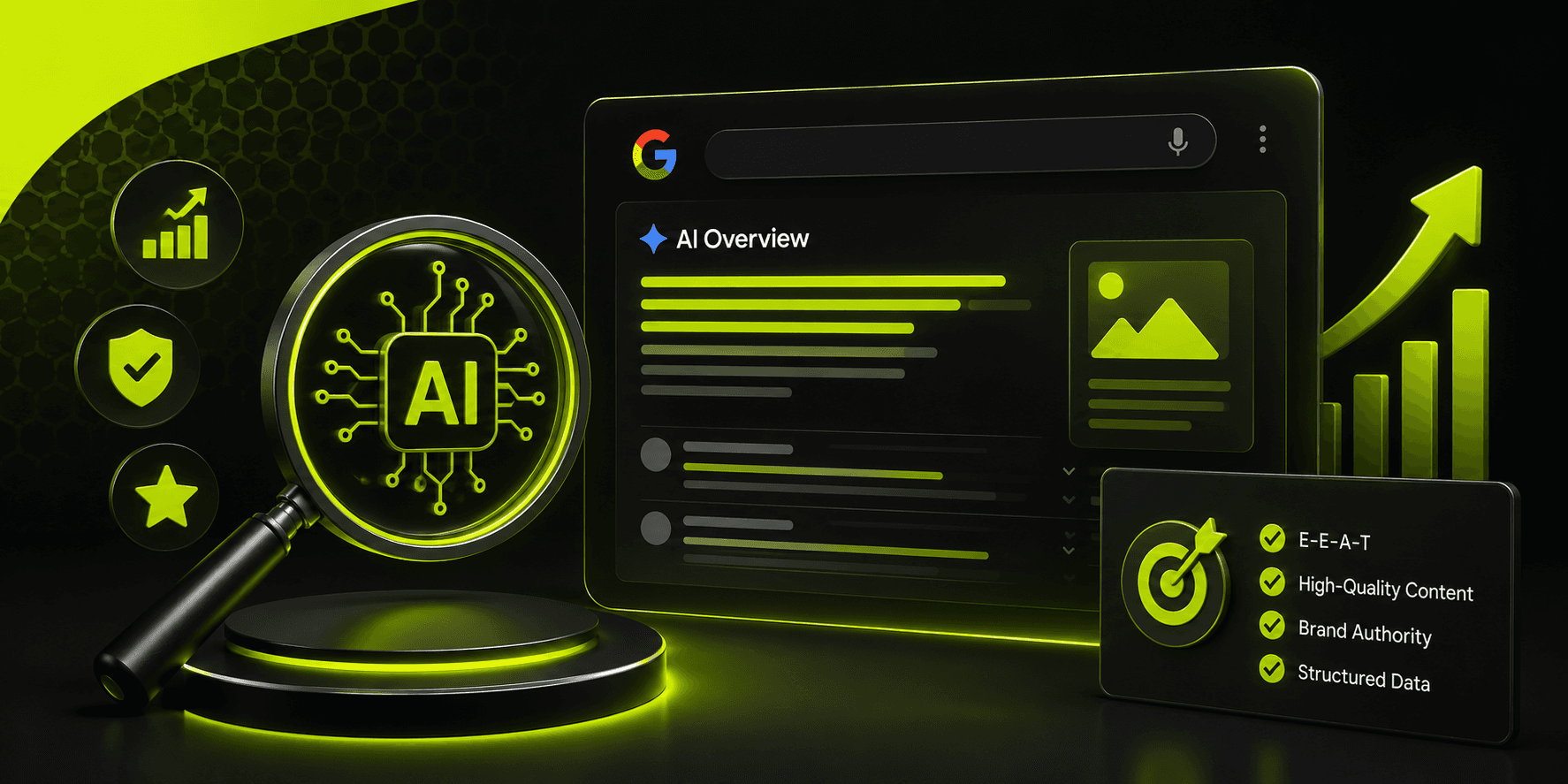
How to Optimize Your Brand for Google AI Overviews in 2026
Google AI Overviews are now the first thing people see. Not your website. Not your ad. Not even your top-ranking blog post. Just an AI-generated answer box that sits above everything else and steals the click.
Here is the short answer: to show up inside Google AI Overviews, your brand needs to be treated as a trusted entity by Google's systems. That means clean structured data, conversational content that directly answers questions, strong external citations, and a brand footprint that AI models can verify across multiple sources.
That sounds simple. It is not. Most businesses are doing SEO the old way and wondering why their traffic is dropping. This guide breaks down exactly what works in 2026.
Key Takeaways
Google AI Overviews pull content from trusted, well-structured web pages, not just the top-ranked ones.
Entity authority matters more than domain authority in AI search environments.
Your brand must be consistently described the same way across your website, press mentions and directories.
Content written in a question-and-answer format has a higher chance of being extracted by AI Overview systems.
Schema markup is now a non-negotiable part of any Google AI Overviews optimization strategy.
GEO (Generative Engine Optimization) is not a replacement for SEO. It works on top of it.
What Are Google AI Overviews and Why They Change Everything
Google AI Overviews are AI-generated summaries that appear at the very top of certain search results. Google pulls text, lists and structured answers from multiple web pages, combines them, and shows one unified answer.
The scary part? The user gets their answer without ever clicking a link. For brands, this is a double-edged sword. If your content is cited inside that box, you get incredible visibility. If it is not, you are effectively invisible for that query.
AI Overviews started rolling out in the United States in 2023. By 2026, they appear in dozens of countries and cover almost every major industry. Google has confirmed they are here to stay.
This is why AI search optimization has become one of the fastest-growing services in digital marketing. Traditional SEO alone is no longer enough.
Why Most Brands Are Not Showing Up in AI Overviews
Most websites were built to rank on Google's traditional blue-link results. That involved keywords, backlinks and meta tags. AI Overviews have different rules. Google's AI systems are not just looking for keyword matches. They are looking for trusted, authoritative, clearly structured content that directly answers a user's question.
Here is what is holding most brands back:
Problem | Why It Hurts AI Overview Visibility |
Generic content with no clear answers | AI cannot extract a specific answer to show users |
No structured data or schema markup | Google bots cannot understand what your page is about |
Inconsistent brand name across web | AI systems cannot verify your entity as trustworthy |
No external citations or press mentions | Low entity authority = low chance of being cited |
Content written for keywords only | Reads as stuffed text, not as genuine expertise |
No FAQ sections on key pages | Misses the question-and-answer format AI Overviews prefer |
Step 1: Build Your Brand Entity the Right Way
Google does not just index pages. It builds a web of entities. An entity is a real-world thing: a person, a business, a product, a location. When Google's AI understands your brand as a clearly defined entity, it becomes much easier to cite you in an AI Overview.
Here is what entity building looks like in practice:
Use the exact same business name, address, and description across every platform you appear on.
Create or update your Google Business Profile with accurate, detailed information.
Get listed on reputable directories like Clutch, G2, Crunchbase, or industry-specific platforms.
Build a Wikipedia or Wikidata entry if your brand qualifies.
Publish press releases on authoritative news platforms so your brand name appears in trusted sources.
Use consistent brand messaging in your website title tags, meta descriptions, and About page.
Think about it this way. If ten different websites all describe your brand the same way, Google's AI treats that as a verified fact. If every website says something different, the AI gets confused and may skip you entirely.
Step 2: Add Schema Markup to Every Important Page
Schema markup is code you add to your website that tells search engines exactly what your content means. It is not visible to users. It is written in a format called JSON-LD and placed in the HTML of your page.
Google's AI Overviews rely heavily on structured data to understand and extract information. If your pages have no schema, the AI has to guess what your content is about. Guessing leads to exclusion.
The schema types that matter most for AI Overview optimization in 2026:
Schema Type | Best Used For |
Organization | Brand identity, contact info, logo, social profiles |
FAQPage | Question-and-answer sections on any page |
Article / BlogPosting | Blog content and educational articles |
Product | Ecommerce product pages |
LocalBusiness | Location-based service businesses |
HowTo | Step-by-step guides and tutorials |
BreadcrumbList | Site navigation structure |
FAQPage schema deserves special attention. When you mark up your FAQ sections with proper schema, Google can pull your questions and answers directly into the AI Overview. This is one of the fastest ways to get featured.
Use Google's free Rich Results Test tool to check if your schema markup is being read correctly. If there are errors, fix them before anything else.
Step 3: Write Content That AI Overviews Actually Want to Pull
Content strategy for AI Overviews is different from traditional blog writing. Google's AI does not care about your word count. It does not care if your article is 3,000 words long. It cares about one thing: can this content directly answer a specific question?
Here is a writing framework that works well for AI Overview inclusion:
Start every section with a direct one or two sentence answer to the question the heading asks.
Use short paragraphs of two to four sentences. Walls of text get skipped by AI systems.
Include numbered lists and bullet points wherever they make sense. AI loves extractable lists.
Write FAQ sections at the bottom of every major page. Use real questions people type into Google.
Avoid fluffy introductions. Get to the point within the first three lines.
Use the exact language your audience uses, not industry jargon.
One thing that is often overlooked: the freshness of content matters. Google AI Overviews tend to pull from pages that have been updated recently. If your core pages have not been touched since 2022, update them. Add new data. Add a 2026 perspective. Signal to Google that your content is current.
SEO Revive's content marketing services are built specifically around this kind of AI-ready content structure. Every piece is written to be extractable.
Step 4: Build External Citations and Brand Mentions
Google's AI does not just trust what you say about yourself. It looks for other sources saying the same things. When authoritative websites mention your brand name alongside your core products or services, that builds what SEO professionals call entity authority.
Ways to build external citations that actually help:
Get featured in industry roundup articles and comparison posts.
Pitch guest articles to authoritative blogs in your niche.
Issue press releases through PR Newswire or similar platforms.
Get reviewed on platforms like G2, Clutch, or Trustpilot.
Create shareable research or data that other sites will link to and mention.
Collaborate with industry associations and get listed as a member or partner.
The quality of citations matters much more than the quantity. One mention from a high-authority trade publication does more for your AI Overview visibility than fifty mentions from low-quality blogs.
Step 5: Optimize Your Google Business Profile for Local AI Overviews
If your business serves a specific location, your Google Business Profile is critical. Local AI Overviews pull directly from GBP data. A poorly managed or incomplete profile means you will not show up in AI-generated answers for local searches.
What to fix right now on your Google Business Profile:
Write a detailed business description using your main keywords naturally.
Add all products and services with full descriptions, not just names.
Upload new photos at least twice a month. Freshness signals trust.
Answer every review. Respond to negative ones professionally.
Post updates regularly through the GBP posts feature.
Enable the Q and A section and pre-populate it with real questions your customers ask.
Google's official Google Business Profile guidelines are updated regularly. Review them to make sure you are not missing any newer features or requirements.
What Is GEO and How It Connects to Google AI Overviews
GEO stands for Generative Engine Optimization. It is the discipline of making your brand visible inside AI-generated answers, not just traditional search results. Google AI Overviews are just one part of the GEO landscape. ChatGPT, Perplexity, Gemini and others are part of it too.
The strategies in this guide overlap heavily with GEO because Google AI Overviews and generative AI tools all pull from the same fundamental signals: entity authority, structured data, authoritative citations, and conversational content.
For a deeper look at how generative engine optimization works across all AI platforms, not just Google, visit SEO Revive's dedicated GEO service page.
The brands that win in 2026 are treating Google AI Overviews as just one channel within a broader AI search strategy. They are not just chasing the blue-link rankings anymore. They are building brand entities that AI trusts.
Technical SEO Factors That Affect AI Overview Inclusion
The basics of technical SEO still matter. Google cannot include your content in an AI Overview if its bots cannot properly crawl and index your pages. A few technical issues can silently block you from appearing.
Technical Factor | What to Check |
Page speed | Core Web Vitals score. Aim for green across all metrics. |
Mobile usability | All pages must be fully functional on mobile devices. |
Crawlability | No pages blocked by robots.txt that should be indexed. |
Canonical tags | No duplicate content issues confusing Google's bots. |
HTTPS | Entire site must be secured. No mixed content warnings. |
Internal linking | Key topic pages must be well-linked from other pages. |
Page indexing | Use Google Search Console to check all important pages are indexed. |
Run a full technical audit using Google Search Console before making any content changes. Fix the technical issues first, then work on content and entity signals.
SEO Revive's search engine optimization service includes a full technical audit as the first step. Many brands are surprised by how many technical issues are silently holding them back.
How to Track If Your Brand Is Appearing in Google AI Overviews
One of the most common questions is: how do you actually know if your brand is being featured? Unlike traditional ranking tracking, AI Overview appearances are not consistently reported in standard SEO tools.
Here is how to monitor it:
Search your core target queries manually in Google and note whether AI Overviews appear and who is cited.
Use Google Search Console to track clicks from AI Overview-style features. Look for featured snippet and AI Overview attributed clicks in Performance reports.
Try tools like Semrush, Ahrefs or Authoritas which have started rolling out AI Overview tracking features in 2025 and 2026.
Prompt ChatGPT, Perplexity and Gemini directly with questions in your niche and see if your brand appears. This is not Google specifically but it reflects your broader entity authority.
Track organic click-through rate drops. A drop in clicks despite stable rankings often signals that an AI Overview is absorbing your traffic.
Tools like Semrush AI Overview tracking are becoming essential for brands that want real visibility into their AI search performance. The landscape is moving fast.
What SEO Revive Actually Thinks About the AI Overview Opportunity
There is a lot of panic in the SEO industry about Google AI Overviews stealing traffic. That panic is understandable but also slightly overblown. Yes, zero-click searches are increasing. Yes, some top-of-funnel informational traffic is being absorbed. But the brands that get cited in those AI Overviews? They are seeing brand awareness spike in ways that are hard to measure but very real.
The bigger opportunity is being missed. Most businesses are still thinking about SEO as a ranking game. AI Overviews are a trust game. Google's AI is essentially asking: which brand does Google trust enough to put its name on as the answer? If your entity signals are strong, your content is structured well, and your citations are solid, you become that brand.
Early movers win in AI search. The brands building entity authority and structured content today are locking in positions that will be very hard to displace later. Waiting is not a neutral choice. It is falling behind.
5 Quick Wins to Start Getting Into Google AI Overviews This Week
Not every optimization takes months. Some changes can start influencing your AI Overview visibility within weeks. Here are the five fastest actions to take:
Add FAQPage schema to your top five pages: Use Google's Structured Data Markup Helper if you do not know how to code it. Add real questions with direct answers.
Rewrite your About page as a brand entity statement: Include your full business name, what you do, who you serve, where you operate, and how long you have been in business. Keep it factual and consistent with other platforms.
Update your top blog posts with 2026 data and fresh insights: Add a 'last updated' date. Mention current trends. Signal that your content is current.
Add a dedicated FAQ section to every service page: Write five to ten real questions your customers ask. Answer each one directly in two to three sentences.
Submit your business to three new authoritative directories this week: Clutch, Crunchbase, and your industry-specific trade association directory are good starting points.
Final Thoughts: AI Overviews Are a Long Game Worth Playing
Google AI Overviews are not a passing trend. They represent how search works now and how it will work for the foreseeable future. The question is not whether to optimize for them. The question is how fast you can move before your competitors lock in those positions.
The good news is that most businesses have not started yet. The gap between brands that understand entity-based AI optimization and those still chasing keywords is wide right now. That gap will close. Getting in early is the real competitive advantage.
If you want a structured plan tailored to your brand, explore the SEO Revive growth formula. It covers the full roadmap from technical fixes to entity building to AI search visibility.
Frequently Asked Questions
What is a Google AI Overview?
A Google AI Overview is an AI-generated summary that appears at the top of some Google search results. It pulls content from multiple web pages and combines it into one answer. Users can see the answer without clicking any link.
How do I get my website featured in Google AI Overviews?
Does traditional SEO help with Google AI Overviews?
Can any website appear in Google AI Overviews?
How long does it take to get into Google AI Overviews?
What types of queries show Google AI Overviews?
Do I need to hire an agency to optimize for AI Overviews?
Is GEO the same as AI Overview optimization?